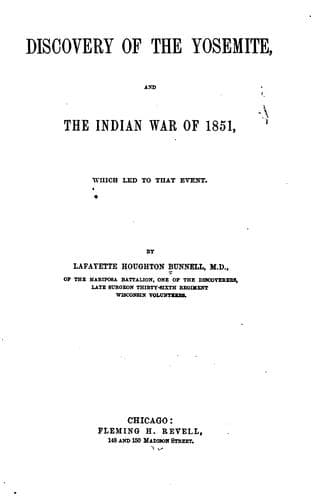
Discovery of the Yosemite, and the Indian War of 1851, Which Led to That EventBunnell, Lafayette Houghton
History
Discovery of the Yosemite, and the Indian War of 1851, Which Led to That Event
Bunnell, Lafayette Houghton
Indians of North America -- California; Pacific Coast Indians, Wars with, 1847-1865; Yosemite Valley (Calif.)
Sandino persisted in trying to make the Captain believe that most of
the Yosemites had already gone through the Mono Pass, and that those
remaining hidden, were but the members of Ten-ie-ya’s family. This
theory was not accepted by Capt. Boling, and occasional scouting
parties would still be sent out. A few of us continued to make short
excursions, more for adventure and to gratify curiosity, than with the
expectation of discovering the hiding places of the Indians; although
we kept up the form of a search. We thus became familiar with most of
the objects of interest.
The more practical of our command could not remain quiet in camp during
this suspension of business. Beside the ordinary routine of camp
duties, they engaged in athletic sports and horse-racing. A very fair
race track was cleared and put in condition, and some of the owners of
fast horses were very much surprised, to see their favorites trailing
behind some of the fleet-footed mules. A maltese Kentucky blooded mule,
known as the “Vining Mule,” distanced all but one horse in the command,
and so pleased was Capt. Boling with its gracefully supple movements,
that he paid Vining for it a thousand dollars in gold.
For a change of amusement, the members of our “Jockey Club” would
mount their animals and take a look at such points of interest as had
been designated in our camp-fire conversations as most remarkable.
The scenery in the Yosemite and vicinity, which is now familiar to so
many, was at that time looked upon with varied degrees of individual
curiosity and enjoyment, ranging from the enthusiastic, to almost a
total indifference to the sublime grandeur presented. It is doubtful
if any of us could have given a very graphic description of what we
saw, as the impressions then received were so far below the reality.
Distance, height, depth and dimensions were invariably under-estimated;
notwithstanding this, our attempts at descriptions after our return to
the settlements, were received as exaggerated “yarns.”
While in Mariposa, upon one occasion not very long after the discovery
of Yosemite, I was solicited by Wm. T. Whitachre, a newspaper
correspondent from San Francisco, to furnish him a written description
of the Valley. This, of course, was beyond my ability to do; but I
disinterestedly complied with his request as far as I could, by giving
him some written details to work upon. On reading the paper over, he
advised me to reduce my estimates of heights of cliffs and waterfalls,
at least fifty per centum, or my judgment would be a subject of
ridicule even to my personal friends. I had estimated El Capitan at
from fifteen hundred to two thousand feet high; the Yosemite Fall at
about fifteen hundred feet, and other prominent points of interest in
about the same proportion.
Public-domain text, read in full here on John Shaqi.
Reviews
Reviews
No reviews yet
Be the first to share your thoughts on this work.
Elsewhere in the archive
Join the Discussion
Join the discussion
Sign in to leave a comment or review.
Sign InorCreate an account