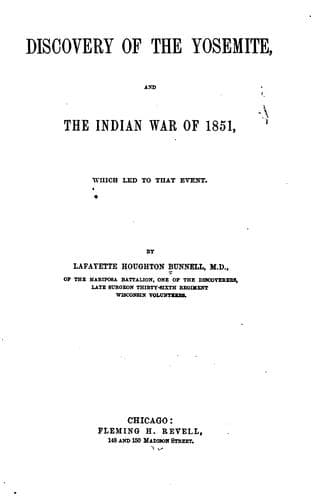
Discovery of the Yosemite, and the Indian War of 1851, Which Led to That EventBunnell, Lafayette Houghton
History
Discovery of the Yosemite, and the Indian War of 1851, Which Led to That Event
Bunnell, Lafayette Houghton
Indians of North America -- California; Pacific Coast Indians, Wars with, 1847-1865; Yosemite Valley (Calif.)
This really beautiful fall was visited by few of our battalion, and
owing to the impracticability of following up the cañon above the
fall, and the great difficulty of access to it, it was left neglected;
the command contenting itself with a distant view. In view of the
discoveries of Mr. Muir that there were glaciers at its source, and
that the cliff now known as “Glacier Point” may be said to mark the
entrance to this “South Cañon,” a name often confounded with “South
Fork,” and especially because of the impropriety of translating this
Indian name, I think it advisable to call this the Glacier Fall, and,
therefore, give it that name in this volume. The name of “Illeuette” is
not Indian, and is, therefore, meaningless and absurd. In accordance
with the customs of these mountain people of naming their rivers
from the most characteristic features of their source, the North or
Ten-ie-ya branch of the Merced, which comes down the North Cañon from
the glistening glacial rocks at its source, was called Py-we-ack,
“the river of glistening rocks,” or more literally, perhaps, “the
river-smoothed rocks.” Whether from Pai, a river, or from Py-ca-bo, a
spring, I am in doubt. If the first syllable of the name Py-we-ack be
derived from Py-ca-bo, then, probably, the name signified to them “the
glistening rock spring branch,” as the ice-burnished rocks at the head
of Lake Ten-ie-ya stand at the source of the river.
I have never been satisfied with the poetical interpretation given the
name, nor with its transfer to “Yan-o-pah,” the branch of the “little
cloud,” as rendered by Mr. Travis. But as Py-we-ack has been displaced
from Lake Ten-ie-ya and its outlet, it is proper and in accordance with
the custom to call the branch Ten-ie-ya also. The name of Ten-ie-ya
was given to the lake at the time of its discovery. It was there we
captured the remnant of the Yosemite band, as will be explained in
the next chapter. The name of Ten-ie-ya Cañon, Ten-ie-ya Fork and
Lake Ten-ie-ya, has for this reason superseded the original name of
Py-we-ack; but in naming the lake, I preserved an Indian name that
represented the central figure in all of our operations.
Public-domain text, read in full here on John Shaqi.
Reviews
Reviews
No reviews yet
Be the first to share your thoughts on this work.
Elsewhere in the archive
Join the Discussion
Join the discussion
Sign in to leave a comment or review.
Sign InorCreate an account