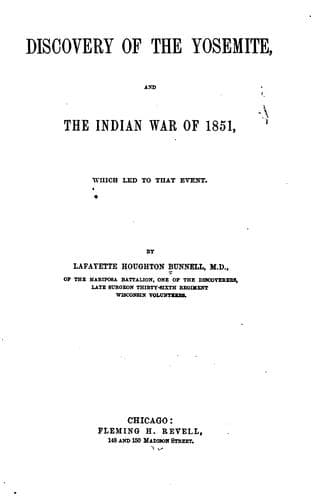
Discovery of the Yosemite, and the Indian War of 1851, Which Led to That EventBunnell, Lafayette Houghton
History
Discovery of the Yosemite, and the Indian War of 1851, Which Led to That Event
Bunnell, Lafayette Houghton
Indians of North America -- California; Pacific Coast Indians, Wars with, 1847-1865; Yosemite Valley (Calif.)
The names of the different objects and localities of especial interest
have now become well established by use. It is not a matter of so
much surprise that there is such a difference in the orthography of
the names. I only wonder that they have been retained in a condition
to be recognized. It is not altogether the fault of the interpreters
that discrepancies exist in interpretation or pronunciation, although
both are often undesignedly warped to conform to the ideality of the
interpreter. Many of the names have been modernized and adorned with
_transparencies_ in order to illuminate the subject of which the
parties were writing. Those who once inhabited this region, and gave
distinctive appellations, have all disappeared. The names given by
them can be but indifferently preserved or counterfeited by their camp
followers, the “California Diggers;” but June is now with us, and we
must hasten on to our work of following up the trail.
CHAPTER XIV.
A Mountain Storm--Delay of Supplies--Clams and Ipecac--Arrival of
Train--A Cute Indian--Indian Sagacity--A Dangerous Weapon--Capture of
Indian Village--An Eloquent Chief--Woman’s Rights _versus_ Squaw’s
Wrongs--A Disturbed Family--A Magnificent Sunrise--On a Slippery
Slope--Sentiment and Poetry--Arrival at the Fresno.
A mountain storm raged with such violence as to stampede the mules
of the pack-train while the escort were encamped on the South Fork.
The mules were not overtaken until they reached the foot-hills of the
Fresno. In the meantime, while impatiently awaiting their return, our
rations gave out. In order to somewhat appease our hunger, Dr. Black
distributed his hospital stores among us. There were some canned fruits
and meats, and several cans of oysters and clams. The southerners of
the command waived their rights to the clams, but cast lots for the
oysters. Thinking we had a prize in the clams, we brought to bear our
early recollections of Eastern life, and compounded a most excellent
and, what we supposed would be, a most nourishing soup. Our enjoyment,
however, of this highly prized New England dish was of short duration;
for from some cause, never satisfactorily explained by Dr. Black, _or
other eminent counsel_, our Eastern mess, as if moved by one impulse
of re-gurgitation, _gave up their clams_. Fortunately for us our
supplies arrived the next morning; for the game procurable was not
sufficient for the command. Major Savage sent Cow-chitty, a brother
of Pon-wat-chee, the chief of the Noot-choo band, whose village we
surprised before we discovered the valley, as chief of scouts. He was
accompanied by several young warriors, selected because they were
all familiar with the Sierra Nevada trails and the territory of the
Pai-utes, where it was thought probable the expedition would penetrate.
Public-domain text, read in full here on John Shaqi.
Reviews
Reviews
No reviews yet
Be the first to share your thoughts on this work.
Elsewhere in the archive
Join the Discussion
Join the discussion
Sign in to leave a comment or review.
Sign InorCreate an account