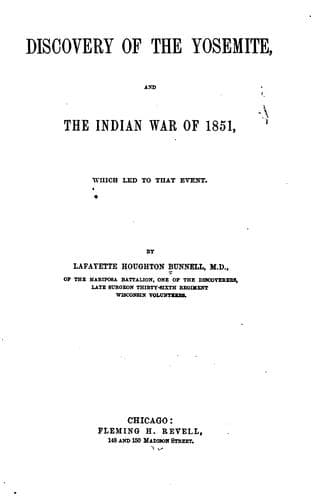
Discovery of the Yosemite, and the Indian War of 1851, Which Led to That EventBunnell, Lafayette Houghton
History
Discovery of the Yosemite, and the Indian War of 1851, Which Led to That Event
Bunnell, Lafayette Houghton
Indians of North America -- California; Pacific Coast Indians, Wars with, 1847-1865; Yosemite Valley (Calif.)
I had accompanied our guide in advance of the command, but observing
that our course was a zig-zag one, some times almost doubling on our
trail, I stopped and told the guide to halt until the Captain came
up. He had been following the ridges without a sign of a trail being
visible, although he had sometimes pointed to small pieces of coarse
granite on the rocky divides, which he said had been displaced by
Ten-ie-ya’s scouts. That in going out or returning from their camps,
they had kept on the rocky ridges, and had avoided tracking the snow or
soft ground, so as to prevent the Americans from following them. As we
stopped, he called me a little out of hearing of those with me, and by
pantomime and a few words indicated his belief in the near presence of
Indians.
When the Captain came up he said: “The hiding-place of the Yosemites
is not far off. If they had crossed the mountains their scouts would
not be so careful to hide their trail. They would follow the old trail
if they came to watch you, because it is direct, and would only hide
their tracks when they were again far from the valley and near their
rancheria.” This was, in part, an answer to Captain Boling’s inquiry
as to why we had left the old trail, and gone so far out of our way.
I explained to him what Cow-chitty had stated, and pointed out what
the guide or scout said was a fresh trail. The Captain looked tired
and disheartened, but with a grim smile said: “That may be a fresh
Indian track, but I can’t see it. If left to my own feelings and
judgment, I should say we were on another wild-goose chase. If the
guide can see tracks, and thinks he has got ’em this time, I reckon
it is better to follow on; but if there is any short-cut tell him to
give us some landmarks to go by; for I find I am not as strong as I
thought. Let us take another look at this _fresh_ trail, and then
you may get Cow-chitty’s idea as to the probable course this trail
will take further on.” As we moved up the trail a little farther, the
expert scout pointed out more fresh signs, but Captain Boling failed to
discern a trail, and gave up the examination, and as he seated himself
for a momentary rest, said: “I reckon it is all right, Doc. The Major
says in his letter that I can bet on Cow-chitty every time. But I can’t
see any more of a trail on this rocky ridge than I can see the trail of
that wood-pecker as he flies through the air, but I have some faith in
instinct, for I reckon that is what it is that enables him to follow a
trail that he imagines should be there. We shall have to trust him to
follow it, and let him have his own way as you would a fox-hound; if he
don’t, puppy-like, take the back track, or run wild with us over some
of these ledges.” Old Ten-ie-ya was now appealed to for information
concerning the fresh signs, but he only reiterated his former statement
that his people had gone over the mountains to the Monos, and the signs
he said were those of Tuolumne Indians. Captain Boling had taken the
Public-domain text, read in full here on John Shaqi.
Reviews
Reviews
No reviews yet
Be the first to share your thoughts on this work.
Elsewhere in the archive
Join the Discussion
Join the discussion
Sign in to leave a comment or review.
Sign InorCreate an account