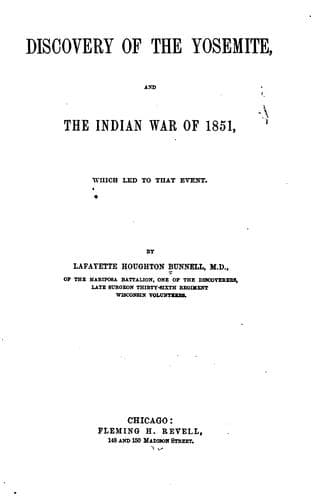
Discovery of the Yosemite, and the Indian War of 1851, Which Led to That EventBunnell, Lafayette Houghton
History
Discovery of the Yosemite, and the Indian War of 1851, Which Led to That Event
Bunnell, Lafayette Houghton
Indians of North America -- California; Pacific Coast Indians, Wars with, 1847-1865; Yosemite Valley (Calif.)
In order to take the most direct route to the valley, Captain Boling
selected one of the young Yosemite Indians to lead the way with our
regular guide. Being relieved of the charge of Ten-ie-ya, I took my
usual place on the march with the guide. This position was preferred
by me, because it afforded ample opportunity for observation and time
for reflection; and beside, it was in my nature to be in advance.
The trail followed, after leaving the lake, led us over bare granite
slopes and hidden paths, but the distance was materially shortened. A
short distance below the bottom land of the lake, on the north side
of the cañon and at the head of the gorge, the smooth, sloping granite
projects like a vast roof over the abyss below. As we approached this,
our young guide pointed toward it.
By close observation I was able to discover that the trail led up its
sloping surface, and was assured by the guide that the trail was a
good one. I felt doubtful of the Captain’s willingness to scale that
rocky slope, and halted for him to come up. The Captain followed the
trail to its termination in the soil, and saw the cause of my having
halted. Upon the discoloration of the rock being pointed out as the
continuation of the trail, he glanced up the granite slope and said,
“Go on, but be watchful, for a slide into the gorge would bring as
certain death as a slide from that San Joaquin trail, which I have not
yet forgotten.” Some of the command did not fancy this any more than
they did the Ten-ie-ya trail down “Indian Cañon.” We all pulled off
our hoots and went up this slope bare-footed. Seeing there was no real
danger, the most timid soon moved up as fearless as the others. I, with
the advance, soon reached the soil above, and at the top halted until
the Indians and our straggling column closed up. As I looked about me,
I discovered, unfolding to my sight, one of the most charming views
in this sublimest scenery of nature. During the day before, we had
looked with astonishment on the almost boundless peaks, and snow-capped
mountains, to be seen from the Mt. Hoffman divide. But here some of the
same views appeared illuminated. In our ascent up the mountain, we had
apparently met the rising sun. The scene was one long to be remembered
for its brilliancy, although not describable.
Public-domain text, read in full here on John Shaqi.
Reviews
Reviews
No reviews yet
Be the first to share your thoughts on this work.
Elsewhere in the archive
Join the Discussion
Join the discussion
Sign in to leave a comment or review.
Sign InorCreate an account