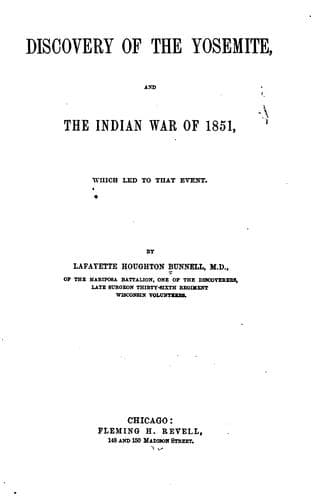
Discovery of the Yosemite, and the Indian War of 1851, Which Led to That EventBunnell, Lafayette Houghton
History
Discovery of the Yosemite, and the Indian War of 1851, Which Led to That Event
Bunnell, Lafayette Houghton
Indians of North America -- California; Pacific Coast Indians, Wars with, 1847-1865; Yosemite Valley (Calif.)
Professor Whitney speaks of still another one of the pine family,
growing about the head of King’s and Kern Rivers, which he calls
_pinus aristata_, and says it only grows on those highest peaks of the
Sierras, although it is also found in the Rocky Mountains. Of the more
noticeable undergrowth of these mountain forests and their borders,
besides grasses, sedges, ferns, mosses, lichens, and various plants
that require a better knowledge of botany than I possess to describe
properly, may be mentioned the California lilac and dogwood, the latter
of which is frequently seen growing along the mountain streams, and in
the Yosemite. It grows in conjunction with alder, willow, poplar, or
balm of Gilead, and a species of buckthorn. In isolated patches the
Indian arrow-wood is found. This wood is almost without pith, and warps
but little in drying. For these qualities and the uniformity of its
growth, it was especially esteemed for arrow-shafts; although sprouts
from other shrubs and trees were also used.
It will have been observed, while going to the Yosemite, that the
chimaso, white-oak and digger-pine are upon the southern slopes,
while the thickets of mountain-ash, shrub or Oregon maple, and shrub
live-oak, chinquepin and trailing blue and white ceanothus and snow
plant are found upon the north side of the ridges, except when found at
a greater altitude than is usual for their growth. On descending into
the Yosemite, the visitor will at once notice and welcome the variety
of foliage.
Upon the highest lands grow pine, fir, cedar, spruce, oak and shrubs.
In the meadows and upon open ground, according to the richness of the
soil and moisture, will be seen flowers and flowering shrubs of great
brilliancy and variety.
The whole valley had the appearance of park-like grounds, with trees,
shrubbery, flowers and lawns. The larger trees, pines, firs, etc., are
of smaller growth than are usually found on the mountain slopes and
tables. Still, some are of fair dimensions, rising probably to the
height of one hundred and fifty feet or more. One large pine, growing
in an alcove upon the wall of Tote-ack-ah-noo-la,--apparently without
soil--is quite remarkable. The balm of gilead, alder, dogwood, willow
and buck-thorn, lend an agreeable variety to the scenery along the
river. Their familiar appearance seem, like old friends, to welcome the
eastern visitor to this strange and remarkable locality. The black-oak
is quite abundant in the valley and upon the slopes below. It was
the source of supply of acorns used by the Yosemites as food, and as
an article of traffic with their less favored neighbors east of the
Sierras.
Public-domain text, read in full here on John Shaqi.
Reviews
Reviews
No reviews yet
Be the first to share your thoughts on this work.
Elsewhere in the archive
Join the Discussion
Join the discussion
Sign in to leave a comment or review.
Sign InorCreate an account