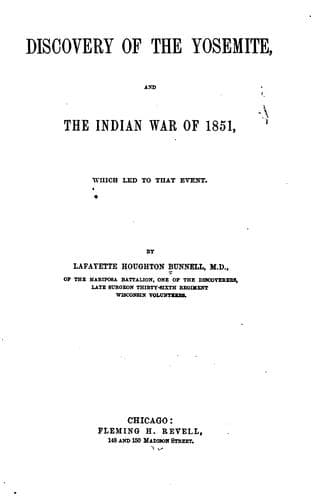
Discovery of the Yosemite, and the Indian War of 1851, Which Led to That EventBunnell, Lafayette Houghton
History
Discovery of the Yosemite, and the Indian War of 1851, Which Led to That Event
Bunnell, Lafayette Houghton
Indians of North America -- California; Pacific Coast Indians, Wars with, 1847-1865; Yosemite Valley (Calif.)
My recollections of the interviews with Colonel McKee, are of a most
agreeable character. The sincerity with which he advised me with regard
to my individual affairs, and the correctness of his representations of
the prospective condition of the Tejon Pass, if it should prove a valid
Mexican grant, was serviceable to me, and subsequent events verified
his judgment. Colonel McKee was a high-minded christian gentleman, but
really unsuited to deal with the political element then existing on the
Pacific-coast. The other two commissioners, Colonel Barbour and Dr.
Woozencroft, I never became acquainted with, though upon one occasion
I met Colonel Barbour at head-quarters, and received a very favorable
impression of his character. In leaving Colonel McKee after my second
interview, I could not at once relinquish my design of ultimately
establishing myself near the Tejon. Having completed my business, I
reported myself to Henderson as ready, and found that he also had
been able to despatch his affairs, and had no business to detain him
longer. Together we took a stroll through the principal street, and
visited some popular resorts. However angelic the unseen portion of
this city--of then less than two thousand inhabitants--may have been,
it appeared to us as a city of fallen angels with their attendant
satellites. Although our observations were made in a dull portion of
the day, we witnessed on the street one pugilistic encounter, two
shooting affrays, and a reckless disregard of life, and property
rights generally, never allowed in a civilized community. We soon
discovered that good arms and a firm demeanor were the only passports
to respectful consideration.
The authorities seemed too indifferent or too timid to maintain order,
or punish the offenders against law. Satisfied that the “City of
Angels” could exhibit more unadulterated wickedness than any other town
in the State at that time, we shook the dust from our feet, and in
order to get an early start the next morning, rode out to the vicinity
of Col. Fremont’s camp. Our party was increased by the addition of
two gentlemen, who joined us for protection and guidance. The name
of one of them has escaped my memory; the other was Doctor Bigelow,
of Detroit, Michigan, a geologist, who at one time was engaged in a
geological survey of a portion of Lake Superior; We left our camp
before sunrise, Henderson and myself riding in advance; our guests,
Indian and pack-mule bringing up the rear. This order of traveling
was maintained as a matter of convenience, for being well mounted,
Henderson and myself were able to secure deer, antelope and a supply of
smaller game, without hardly leaving the trail or delaying our progress.
Public-domain text, read in full here on John Shaqi.
Reviews
Reviews
No reviews yet
Be the first to share your thoughts on this work.
Elsewhere in the archive
Join the Discussion
Join the discussion
Sign in to leave a comment or review.
Sign InorCreate an account