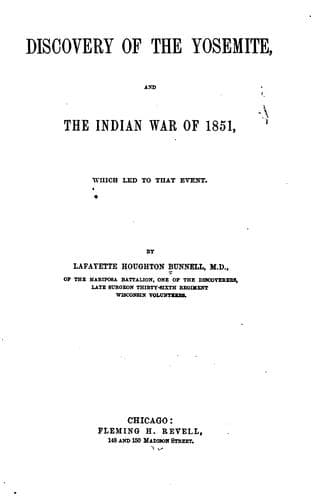
Discovery of the Yosemite, and the Indian War of 1851, Which Led to That EventBunnell, Lafayette Houghton
History
Discovery of the Yosemite, and the Indian War of 1851, Which Led to That Event
Bunnell, Lafayette Houghton
Indians of North America -- California; Pacific Coast Indians, Wars with, 1847-1865; Yosemite Valley (Calif.)
Our animals, like ourselves, seemed to feel in elevated spirits, and
as we vaulted into our saddles at an early hour, they moved rapidly
along in the cool and bracing air. As we rode, drove after drove of
antelope and elk were seen, and one small band of mustangs approached
from the west, when, after vainly neighing to our mules, they turned
and galloped back toward their favorite resort, the west side of the
valley. Sometimes, with a halting look of scrutiny, a coyote would
cross our trail, but their near vicinity was always recognized by our
vigilant mules with a snort and pause in their gait, that was probably
designed to intimate to us that it might be another bear. We beguiled
the time in discussing the amazing fertility of the country we were
traversing, and the probability of its future occupancy. At the present
time, thriving cities and immense wheat fields occupy localities where
in 1851 game and wild mustangs roamed almost undisturbed by the white
man’s tread, or the flash or gleam of his unerring rifle. There is
still room for the enterprising settler, and the upper end of the San
Joaquin Valley may yet be called the sportsman’s paradise. The lakes
and streams swarm with fish, and are the resort of water-fowl, and
deer, elk and antelope are still plentiful in secluded localities.
We reached the Fresno in safety without interrupting incidents, and
without further attempt at exploration. Colonel Henderson, Doctor
Bigelow, and his companion _du voyage_, after a short halt passed on
to Quartzberg, while I stopped over to make my report to the Major. To
my extreme surprise, Major Savage questioned me as to the cause of my
tardiness, saying he had been expecting me for two or three days past,
and that the cattle were now within the valley and would in a short
time be at the reservation. After sufficiently enjoying my astonishment
at his knowledge of my movements and those of Fremont’s herders, he
informed the that his old power and influence over the Indians had
been re-established, and that reports came to him from the different
chiefs of all important events transpiring in their territory. He
soon satisfied me that through a judicious distribution of presents
to the runners, and the esteem in which he was held by the chiefs, he
was able to watch the proceedings of strangers, for every movement
of our party had been reported to him in detail. I was cordially
received by the Major, as a guest in his new trading house, which he
had erected during our absence. We discussed the probable future of
the management of Indian affairs in California, and the incidents of
my trip to Los Angelos. The Major informed me that the battalion had
been mustered out of service during my absence (on July 25th, 1851),
but that my interests had been properly represented and cared for, as
far as he had been able to act without my presence. But in order to
receive compensation as interpreter and for extra medical services, it
Public-domain text, read in full here on John Shaqi.
Reviews
Reviews
No reviews yet
Be the first to share your thoughts on this work.
Elsewhere in the archive
Join the Discussion
Join the discussion
Sign in to leave a comment or review.
Sign InorCreate an account