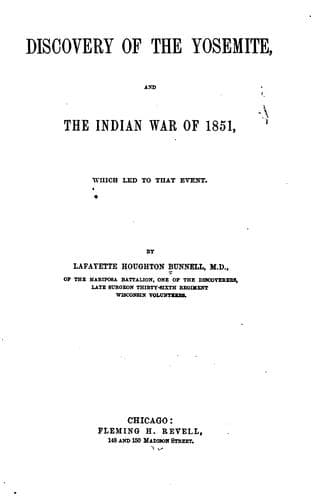
Discovery of the Yosemite, and the Indian War of 1851, Which Led to That EventBunnell, Lafayette Houghton
History
Discovery of the Yosemite, and the Indian War of 1851, Which Led to That Event
Bunnell, Lafayette Houghton
Indians of North America -- California; Pacific Coast Indians, Wars with, 1847-1865; Yosemite Valley (Calif.)
The reports of these murders, alarmed many of the citizens. They
were fearful that the Indians would become excited and leave the
reservations, in which case, it was thought, a general outbreak would
result. The management of the Fresno agency was censured for allowing
Ten-ie-ya to return to the valley, and for allowing so considerable
a number of his followers to again assemble under his leadership.
Among the miners, this alarm was soon forgotten, for it was found that
instead of leaving the reservations, the Indians camped outside, fled
to the agencies for protection, lest they should be picked off in
revenge for the murders perpetrated by the Yo-sem-i-tes. The officer in
command at Fort Miller, was notified of these murders, and a detachment
of regular soldiers under Lt. Moore, U. S. A., was at once dispatched
to capture or punish the red-skins. Beside the detachment of troops,
scouts and guides, and a few of the friends of the murdered men
accompanied the expedition. Among the volunteer scouts, was A. A. Gray,
usually called “Gus” Gray. He had been a member of Captain Boling’s
company and was with us, when the valley was discovered, as also on our
second visit to the valley under Captain Boling. He had been a faithful
explorer, and his knowledge of the valley and its vicinity, made his
services valuable to Lt. Moore, as special guide and scout for that
locality. The particulars of this expedition I obtained from Gray. He
was afterward a Captain under Gen. Walker, of Nicaragua notoriety.
Under the guidance of Gray, Lt. Moore entered the valley in the night,
and was successful in surprising and capturing a party of five savages;
but an alarm was given, and Ten-ie-ya and his people fled from their
huts and escaped. On examination of the prisoners in the morning, it
was discovered that each of them had some article of clothing that had
belonged to the murdered men. The naked bodies of Rose and Shurbon were
found and buried. Their graves were on the edge of the little meadow
near the Bridal Vail Fall.
When the captives were accused of the murder of the two white men, they
did not deny the charge; but tacitly admitted that they had done it to
prevent white men from coming to their valley. They declared that it
was their home, and that white men had no right to come there without
their consent.
Lieutenant Moore told them, through his interpreter, that they had
sold their lands to the Government, that it belonged to the white men
now; that the Indians had no right there. They had signed a treaty
of peace with the whites, and had agreed to live on the reservations
provided for them. To this they replied that Ten-ie-ya had never
consented to the sale of their valley, and had never received pay for
it. The other chiefs, they said, had no right to sell their territory,
and no right to laugh at their misfortunes.
Public-domain text, read in full here on John Shaqi.
Reviews
Reviews
No reviews yet
Be the first to share your thoughts on this work.
Elsewhere in the archive
Join the Discussion
Join the discussion
Sign in to leave a comment or review.
Sign InorCreate an account