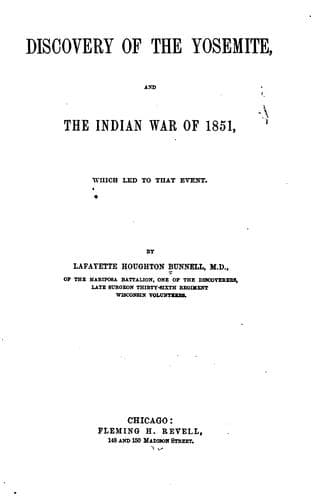
Discovery of the Yosemite, and the Indian War of 1851, Which Led to That EventBunnell, Lafayette Houghton
History
Discovery of the Yosemite, and the Indian War of 1851, Which Led to That Event
Bunnell, Lafayette Houghton
Indians of North America -- California; Pacific Coast Indians, Wars with, 1847-1865; Yosemite Valley (Calif.)
After the establishment of the “Mariposa Chronicle” by W. T. Witachre
and A. S. Gould, the first number of which was dated January 20, 1854.
Lieutenant Moore, to more fully justify himself or gratify public
curiosity, published in the “Chronicle” a letter descriptive of the
expedition and its results. In this letter he dropped the terminal
letter “y” in the name “Yosemity,” as it had been written previously
by myself and other members of the battalion, and substituted “e,” as
before stated. As Lieutenant Moore’s article attracted a great deal of
public attention at that time, the name, with its present orthography,
was accepted. A copy of the paper containing Moore’s letter was in my
possession for many years, but, finally, to my extreme regret, it was
lost or destroyed.
To Lieutenant Moore belongs the credit of being the first to attract
the attention of the scientific and literary world, and “The Press”
to the wonders of the Yosemite Valley. His position as an officer of
the regular army, established a reputation for his article, that could
not be expected by other correspondents. I was shown by Gray, who was
exhibiting them in Mariposa, some very good specimens of gold quartz,
that were found on the Moore expedition. Leroy Vining, and a few chosen
companions, with one of Moore’s scouts as guide, went over the Sierras
to the place where the gold had been found, and established themselves
on what has since been known as Vining’s Gulch or Creek.
On the return of Lieutenant Moore to Fort Miller, the news of his
capture of the Indians, and his prompt execution of them as the
murderers of Rose and Shurbon, occasioned some alarm among the timid,
which was encouraged and kept alive by unprincipled and designing
politicians. All kinds of vague rumors were put in circulation. Many
not in the secret supposed another Indian war would be inaugurated.
Political factions and “Indian Rings” encouraged a belief in the most
improbable rumors, hoping thereby to influence Congressional action,
or operate upon the War Department to make large estimates for the
California Indian Service.
Public-domain text, read in full here on John Shaqi.
Reviews
Reviews
No reviews yet
Be the first to share your thoughts on this work.
Elsewhere in the archive
Join the Discussion
Join the discussion
Sign in to leave a comment or review.
Sign InorCreate an account