Discovery of the Yosemite, and the Indian War of 1851, Which Led to That EventBunnell, Lafayette Houghton
History
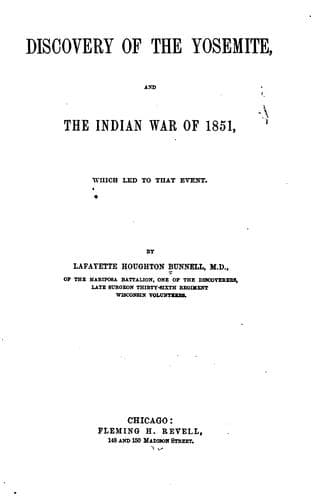
Discovery of the Yosemite, and the Indian War of 1851, Which Led to That Event
Bunnell, Lafayette Houghton
Indians of North America -- California; Pacific Coast Indians, Wars with, 1847-1865; Yosemite Valley (Calif.)
The making of a treaty of peace with Indian tribes, may be correctly
defined as procuring a release of all claims of certain territory
occupied by them. Congress may make appropriations to provide for the
promises made, but it is a well known fact that these appropriations
are largely absorbed by the agents of the government, without the
provisions being fulfilled. The defrauded victims of the _treaty_ are
looked upon as pauper wards of a generous nationality; and the lavish
expenditure of the Government, is mostly consumed by the harpies who
hover around these objects of national charity. This farce of making
treaties with every little tribe as a distinct nationality, is an
absurdity which should long ago have been ended. With formal ceremony,
a treaty of peace is made with people occupying territory under the
jurisdiction of our national organization. A governmental power is
recognized in the patriarchal or tribal representatives of these
predatory bands, and all the forms of a legal and national obligation
are entered into, only to be broken and rebroken, at the will of some
succeeding administration.
An inherited possessive right of the Indians to certain territory
required for their use, is acknowledged, and should be, by the
Government, but to recognize this as a tribal or national right, is but
to continue and foster their instinctive opposition to our Government,
by concentrating and inflaming their native pride and arrogance.
The individual, and his responsibilities, become lost in that of his
tribe, and until that power is broken, and the individual is made to
assume the responsibilities of a man, there will be but little hope
of improvement. The individual is now scarcely recognized by the
people (except he be representative); he is but an integral number
of a tribe. He has a nationality without a country, and feels that
his people have no certain home. He knows that he has been pauperized
by contact with the whites and the policy pursued by the Government
towards him, and he scorns, while he accepts its bounty. These
native-born residents of our common country, are not citizens; their
inherent rights are not sufficiently protected, and, feeling this, they
in turn, disregard the law or set it at defiance. The best part of my
life has been spent upon the frontiers of civilization, where ample
opportunities have been afforded me to observe our national injustice
in assuming the guardianship and management of the Indian, without
fulfilling the treaty stipulations that afford him the necessary
protection. The policy of the Government has seemed to be to keep them
under restraint as animals, rather than of protective improvement as
rational human beings. What matters it, though the National Government,
by solemn treaty, pledges its faith to their improvement, if its
agents do not fulfill its obligations. I am no blind worshipper of
the romantic Indian, nor admirer of the real one; but his degraded
Public-domain text, read in full here on John Shaqi.
Reviews
Reviews
No reviews yet
Be the first to share your thoughts on this work.
Elsewhere in the archive
Join the Discussion
Join the discussion
Sign in to leave a comment or review.
Sign InorCreate an account