Discovery of the Yosemite, and the Indian War of 1851, Which Led to That EventBunnell, Lafayette Houghton
History
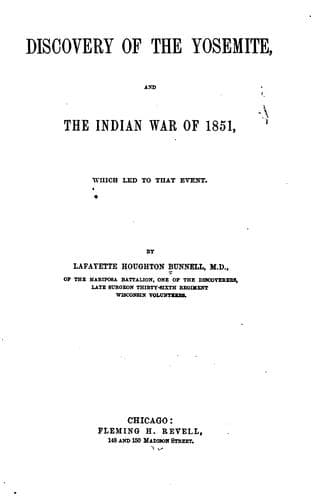
Discovery of the Yosemite, and the Indian War of 1851, Which Led to That Event
Bunnell, Lafayette Houghton
Indians of North America -- California; Pacific Coast Indians, Wars with, 1847-1865; Yosemite Valley (Calif.)
I furnished them some tools to prospect, and they came back sanguine of
success. A Tu-ol-um-ne Indian named “Joe,” and two or three families
of Yosemities came down and camped on Bull Creek and commenced to
gather acorns, while “Joe” as head miner, worked with the others in the
gulches and on the North Fork. This experiment of working and reforming
robbers soon proved a failure, for upon the death of one of them who
had been injured, they could not be induced to remain or work any
longer, and “Joe,” and his new followers stampeded for the Hetch-Hetchy
Valley.
From these Indians, and subsequently from others, I learned the
following statements relative to the death of Old Ten-ie-ya. After the
murder of the French miners from Coarse Gold Gulch, and his escape from
Lieut. Moore, Ten-ie-ya, with the larger part of his band, fled to the
east side of the Sierras. He and his people were kindly received by the
Monos and secreted until Moore left that locality and returned to Fort
Miller.
Ten-ie-ya was recognized, by the Mono tribe, as one of their number, as
he was born and lived among them until his ambition made him a leader
and founder of the Pai-Ute colony in Ah-wah-ne. His history and warlike
exploits formed a part of the traditionary lore of the Monos. They were
proud of his successes and boasted of his descent from their tribe,
although Ten-ie-ya himself claimed that his father was the chief of an
independent people, whose ancestors were of a different race. Ten-ie-ya
had, by his cunning and sagacity in managing the deserters from other
tribes, who had sought his protection, maintained a reputation as a
chief whose leadership was never disputed by his followers, and who
was the envy of the leaders of other tribes. After his subjugation by
the whites, he was deserted by his followers, and his supremacy was no
longer acknowledged by the neighboring tribes, who had feared rather
than respected him or the people of his band. Ten-ie-ya and his refugee
band were so hospitably received and entertained by the Monos that they
seemed in no hurry to return to their valley.
Public-domain text, read in full here on John Shaqi.
Reviews
Reviews
No reviews yet
Be the first to share your thoughts on this work.
Elsewhere in the archive
Join the Discussion
Join the discussion
Sign in to leave a comment or review.
Sign InorCreate an account