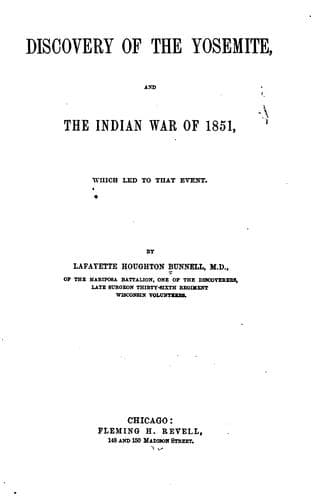
Discovery of the Yosemite, and the Indian War of 1851, Which Led to That EventBunnell, Lafayette Houghton
History
Discovery of the Yosemite, and the Indian War of 1851, Which Led to That Event
Bunnell, Lafayette Houghton
Indians of North America -- California; Pacific Coast Indians, Wars with, 1847-1865; Yosemite Valley (Calif.)
I learned soon after, from some miners from the mouth of the “South
Fork,” that all of the Yosemites who had camped on the flats below the
cañon, had left suddenly for the Tuolumne. These two parties were the
first white men that visited the Yosemite Valley after the visit of
Lieut. Moore, the year before (1852). The names of these miners have
now passed from my memory, but I afterwards met one of these gentlemen
at Mr. George W. Coulter’s Hotel, in Coultersville, and another at Big
Oak Flat, and both seemed well known to Lovely Rogers and other old
residents. I was shown, by the first party, some good specimens of gold
quartz that had been found on the north side of the Merced below the
cañon. Late in the fall of this year (1853), three of the remnant of
Ten-ie-ya’s band came to our store. They did not offer to trade, and
when questioned, told me that they had been camping on the Tuolumne,
and had come down to the Merced to get some fish. I gave them some
provisions, and they left, apparently satisfied if not thankful. A
few nights afterwards, one of our best mules disappeared. This mule
was a favorite mountain animal, sure footed and easy gaited under the
saddle. In following up its tracks, I discovered that it had been
stolen by Indians, and my suspicions were that my Yosemite friends were
the culprits. I made every effort to recover the animal, but without
success.
After the close of the mining season in the fall of 1853, we left our
trading establishment and mining works in charge of two men in our
employ, Robt. D. Sevil, of Smyrna, Delaware, and Robt. Smith, a Dane.
The establishment was visited from time to time, by either Barton or
myself during the winter of 1853-54, when upon one occasional visit,
it was found by Mr. Barton to have been plundered. With Nat. Harbert,
a brave Texan, I at once started for the establishment, only to find
it a scene of desolation. I was informed by some miners who had been
out prospecting, that the body of Smith had been found on a slaty
point in the river below, but that nothing could be discovered of
Sevil, or the murderers. We found the tracks of Indians and traced
them to the mountains, but failed to find their hiding places. We lost
their trail over the bare, slaty ground above the river. The tracks
had indicated to us that Indians were the murderers, before we had
learned from the miners the circumstances connected with the finding
of Smith’s body. It had been pierced by nine arrows, five of which
were still found quivering in his flesh. Upon the discovery of the
body by the miners, a burial party was led by Doctor Porter, from the
North Fork, to the scene of the murders; and with the assistance of his
associates, Mr. Long, and others, it was given proper burial. The body
of Sevil was not found until long afterwards. When discovered, it was
undistinguishable, but from the location in the river, we had no doubt
of its identity. I reported the murders and robbery to the authorities
Public-domain text, read in full here on John Shaqi.
Reviews
Reviews
No reviews yet
Be the first to share your thoughts on this work.
Elsewhere in the archive
Join the Discussion
Join the discussion
Sign in to leave a comment or review.
Sign InorCreate an account