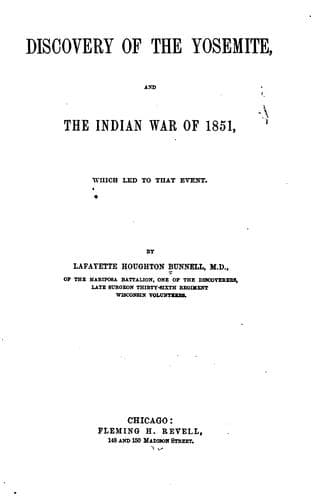
Discovery of the Yosemite, and the Indian War of 1851, Which Led to That EventBunnell, Lafayette Houghton
History
Discovery of the Yosemite, and the Indian War of 1851, Which Led to That Event
Bunnell, Lafayette Houghton
Indians of North America -- California; Pacific Coast Indians, Wars with, 1847-1865; Yosemite Valley (Calif.)
Although I failed to recognize our visitors among these miserable
people; it was quite evident that I was known to them. I asked “who
it was that had killed the men at our store?” They at first pretended
not to understand me; but seeing that they were not believed, one came
forward, and in a mixture of Spanish and Indian informed me that it was
the Tuolume Indians that were the criminals; while they themselves (if
not the cleanest) were certainly the best Indians in the mountains.
Upon being asked why they were camped in such a place--without water,
they said they were at first afraid of our party and the glistening
instrument that had been aimed at them; but, that when they saw we
were measuring the ground, and marking the trees, they were no longer
alarmed, but were afraid of the Monos, whom they said were still angry
with them. I told them that it was because of their treachery and
dishonesty that they had been made to suffer, and then left them in
their wretchedness.
Quite early in the next year (1856), the survey for the water supply
was recommenced under instructions from Colonel Fremont, and, under
direction of his chief engineer, Mr. J. E. Clayton, Mr. Peterson was
placed in charge of the field-work. This work was executed with great
care, as on its accuracy the estimates depended. They were to be made
by a very eminent engineer of the Erie Canal, upon whose report, it was
supposed, Wall street would be governed. Peterson engaged me as his
assistant in this survey. During this season the Mann Brothers finished
their trail to the Yosemite, so that it was used by visitors. Hearing
that they had felled some immense trees and bridged the South Fork,
Mr. Peterson had hopes to reach the valley earlier in the season by
crossing the river at that place.
On reaching the South Fork, where we supposed the bridge to be we
found that a large tree had been felled across the stream with the
design of forming the foundation of a bridge, but it had fallen so
low, or so near the water on the opposite side, that a flood would be
likely to sweep it away, and it had, therefore, been abandoned. This
was a great disappointment to Mr. Peterson. As we could not ford the
stream, we would have to go into camp or wait for the water to fall or
go back, for the snow-clad ridges were impassable. While Peterson was
considering the matter, I took an axe and sloped and notched the butt
of the tree so that I was able to get my horse, an intelligent animal,
to clamber up on the prostrate trunk; when, without difficulty, I led
him safely across and landed him on the other side of the stream. We
had two mules, whose natural timidity caused them to hesitate before
attempting to climb the log, but their attachment for the horse, which
they had seen safely cross, with some _persuasion_ effected with a
stout cudgel counteracted their fears, and they too were safely led
over.
Public-domain text, read in full here on John Shaqi.
Reviews
Reviews
No reviews yet
Be the first to share your thoughts on this work.
Elsewhere in the archive
Join the Discussion
Join the discussion
Sign in to leave a comment or review.
Sign InorCreate an account