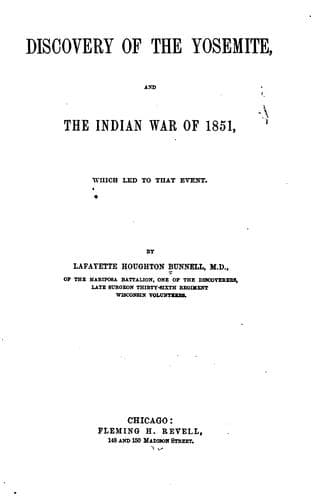
Discovery of the Yosemite, and the Indian War of 1851, Which Led to That EventBunnell, Lafayette Houghton
History
Discovery of the Yosemite, and the Indian War of 1851, Which Led to That Event
Bunnell, Lafayette Houghton
Indians of North America -- California; Pacific Coast Indians, Wars with, 1847-1865; Yosemite Valley (Calif.)
The secret of the _burnt beans_, was known to all the others, but was
kept inviolate from the Colonel. He was unconscious of the joke, and
bestowed more attention on this standard New England dish than he did
upon the delicious trout and game. Our dinner was finished in bumpers
to Colonel Riply as _chef de cuisine_.
During the survey of the year, in addition to measurements, we gave
some attention to the geological features of the country we were
passing over. We found that the cañon below the Yosemite is about six
miles long, and so filled with vast granite bowlders and talus, that
it is impossible for any but the agile and sure-footed to pass safely
through. The river has to be crossed and recrossed so many times, by
jumping from bowlder to bowlder, where the water goes whirling and
dashing between--that if the rocks be moss-grown or slimy, as they may
be outside of continuous current--one’s life is endangered. During our
survey through this cañon, in the month of November, 1855, we failed to
get through in one day on our preliminary survey, and were compelled to
camp without food or blankets, only sheltered from a storm--half snow,
half rain--by an overhanging rock. The pelting mountain storm put out
our fires, as it swept down the cañon, and baffled all our attempts to
kindle a new flame.
The fall through the cañon is so great, that none but the largest
bowlders remain in the current. Some of these immense rocks are so
piled, one upon another, as to make falls of nearly one hundred feet.
The fall for the entire distance is about fifteen hundred feet.
Notwithstanding the fall is so great in so short a distance, advantage
may be taken of the configuration of the walls on either side to
construct a railroad up through the cañon into the valley, upon a
grade and trestle, that may be made practicable. This will, of course,
cost money, but it will probably be done. By tunneling the divide and
spanning the South Fork with a bridge, a narrow-gauge road could very
readily be built that would avoid the necessity of going _entirely_
through the cañon. This could be accomplished most economically by
trestling over the talus--at a favorable point--high enough to obtain
and preserve a suitable grade, until the sloping mountains below can
be reached, when the line can be run without difficulty to the most
favorable point of crossing the divide and the South Fork.
The obstructions from snow, encountered in a winter trip to the valley,
would by this route, be entirely avoided. Beside, the distance would be
somewhat lessened. By rail and stage it is now about 225 miles from San
Francisco.
Public-domain text, read in full here on John Shaqi.
Reviews
Reviews
No reviews yet
Be the first to share your thoughts on this work.
Elsewhere in the archive
Join the Discussion
Join the discussion
Sign in to leave a comment or review.
Sign InorCreate an account