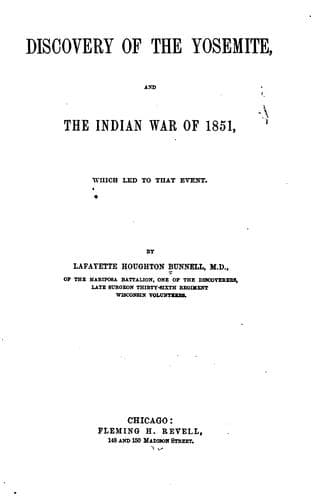
Discovery of the Yosemite, and the Indian War of 1851, Which Led to That EventBunnell, Lafayette Houghton
History
Discovery of the Yosemite, and the Indian War of 1851, Which Led to That Event
Bunnell, Lafayette Houghton
Indians of North America -- California; Pacific Coast Indians, Wars with, 1847-1865; Yosemite Valley (Calif.)
The trail completed this year by the Mann brothers required greater
labor, and was not as good a route, but the views of the Yosemite from
their trail, were the best. The Mann brothers did not find theirs
a paying investment. They never realized their expenditures, and
eventually sold the trail at a loss.
In locating the Coultersville trail, little or no aid was afforded me
by the Indian trails that existed at that time; for horses had not
seemingly been taken into the valley on the north side, and the foot
trails used by the Indians left no traces in the loose granite soil
of the higher ridges, but what were soon obliterated by the wash from
the melting snow. Where trails were found, they had been purposely
run over ground impassable to horses, and they were, consequently,
unavailable for our use. Through liberal aid from the “Empire State
Mining Company,” located at their quartz lode near the Marble Springs,
Mr. Barton and myself had built a wagon road from Coultersville to Bull
Creek. This road afforded a good commencement for the Yosemite trail.
The first encampment reached after leaving Bull creek, was “Deer Flat,”
so named by us from having startled a small drove, as we went into camp
here. One of the deer was shot, and afforded an addition to our camp
supplies.
The next camp named was “Hazel Green,” from the number of hazel bushes
growing near a beautiful little meadow.
Our next move was to “Crane Flat.” This name was suggested by the
shrill and startling cry of some sand-hill cranes we surprised as they
were resting on this elevated table. Going from this camp, we came to
what I finally called “Tamarack Flat,” although the appealing looks of
the grizzlies we met on their way through this pass to the Tuolumne,
caused me to hesitate before deciding upon the final baptism; the
Grizzlies did not stay to urge any claim, and being _affectionately_
drawn to the trees, we named the camp “Tamarack Flat.” From this flat
I blazed out two trails, the lower one for early, the upper for later
use; as from this point the snow remains upon the upper trail until
quite late; and although much nearer, the snow renders it difficult
to travel in the early part of the season. From “Tamarack Flat” to
the edge of the valley is but little more than three miles. The whole
distance from Coultersville being 41½ miles as stated by Prof. Whitney.
With but little fatigue to one accustomed to the saddle, the trip
_down_ to Coultersville or to Mariposa was made in a day.
Public-domain text, read in full here on John Shaqi.
Reviews
Reviews
No reviews yet
Be the first to share your thoughts on this work.
Elsewhere in the archive
Join the Discussion
Join the discussion
Sign in to leave a comment or review.
Sign InorCreate an account