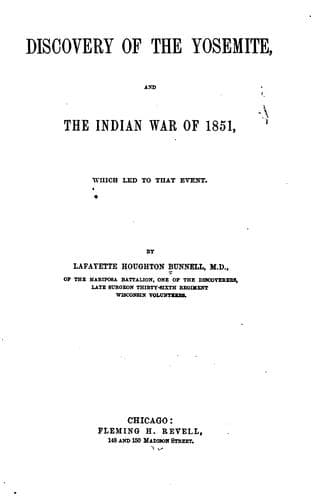
Discovery of the Yosemite, and the Indian War of 1851, Which Led to That EventBunnell, Lafayette Houghton
History
Discovery of the Yosemite, and the Indian War of 1851, Which Led to That Event
Bunnell, Lafayette Houghton
Indians of North America -- California; Pacific Coast Indians, Wars with, 1847-1865; Yosemite Valley (Calif.)
“The theory of erosion not being admissible to account for the
formation of the Yosemite valley, we have to fall back on some one
of those movements of the earth’s crust to which the primal forms
of mountain valleys are due. The forces which have acted to produce
valleys are complex in their nature, and it is not easy to classify
the forms, which have resulted from them, in a satisfactory manner.”
After describing the generally received theories of mountain and valley
formations, Mr. Whitney says: “We conceive that, during the process
of upheaval of the Sierra, or possibly at some time after that had
taken place, there was at the Yosemite a subsidence of a limited area,
marked by lines of ‘fault’ or fissure crossing each other somewhat
nearly at right angles. In other and more simple language, the bottom
of the valley sank down to an unknown depth, owing to its support being
withdrawn from underneath, during some of those convulsive movements
which must have attended the upheaval of so extensive and elevated a
chain, no matter how slow we may imagine the process to have been.
Subsidence over extensive areas of portions of the earth’s crust is not
at all a new idea in geology, and there is nothing in this peculiar
application of it which need excite surprise. It is the great amount
of vertical displacement for the small area implicated which makes
this a peculiar case; but it would not be easy to give any good reason
why such an exceptionable result should not be brought about amid the
complicated play of forces which the elevation of a great mountain
chain must set in motion. By the adoption of the subsidence theory for
the formation of the Yosemite, we are able to get over one difficulty
which appears insurmountable to any other. This is the very small
amount of debris at the base of the cliffs, and, even at a few points,
its entire absence.” In the space allotted to this chapter, I am able
only to quote a few passages from Prof. Whitney, but refer the curious
to his recent work, “Climatic Changes of Later Geological Times.”
Public-domain text, read in full here on John Shaqi.
Reviews
Reviews
No reviews yet
Be the first to share your thoughts on this work.
Elsewhere in the archive
Join the Discussion
Join the discussion
Sign in to leave a comment or review.
Sign InorCreate an account