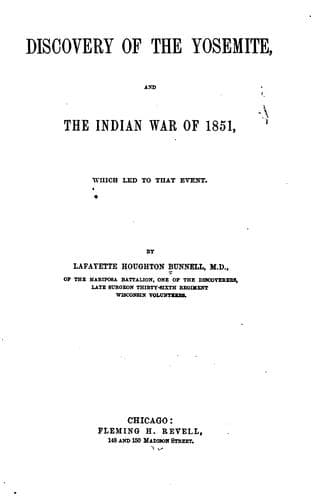
Discovery of the Yosemite, and the Indian War of 1851, Which Led to That EventBunnell, Lafayette Houghton
History
Discovery of the Yosemite, and the Indian War of 1851, Which Led to That Event
Bunnell, Lafayette Houghton
Indians of North America -- California; Pacific Coast Indians, Wars with, 1847-1865; Yosemite Valley (Calif.)
Among forests of such very large pines, cedar and fir trees, as grow
adjacent to and among the sequoia, an unusually large tree would not
probably have attracted much attention. Had a grove of them, however,
been discovered, the fact would have been spoken of in the battalion.
As the species was not known to any of us at the time, even had any
been seen, and even the pendant character of their branches noticed,
doubtless they would have been classed and spoken of as “_cedar_.” I do
not believe, however, that any of the battalion ever _noticed_ these
trees, for the reason that strict orders were given against straggling,
and our explorations were, for the most part, in the mountains _above_
the line of growth of the sequoia. While hunting for game, during our
first expeditions, the depth of snow forced the hunt below.
A few of the Mariposa big trees were first brought into notice by the
discoveries of Mr. Hogg in the summer of 1855. The year previous, Mr.
Hogg was in the employ of Reynolds, Caruthers and myself, and proving
an able assistant and expert hunter, he was employed by our successors,
the “South Fork Ditch Company,” to supply them with game. During one of
his hunting expeditions, Mr. Hogg discovered some sequoia on a branch
of “Big Creek,” and relating his discoveries to Mr. Galen Clark, Mr.
Mann and others, the exact locality was indicated, and became known.
During the autumn of this year (1855), other trees were discovered
by Mr. J. E. Clayton, while exploring and testing, by barometrical
measurements, the practicability of bringing water from the branches
of the San Joaquin to increase the supply from the South Fork of
the Merced. Upon Mr. Clayton’s second visit, a few days later, I
accompanied him, and was shown his discoveries.
About the first of June, 1856, Galen Clark and Milton Mann discovered
what has now become famous as the “Mariposa Grove.” The next season Mr.
Clark came upon two smaller groves of sequoia in the near vicinity of
the big grove. Not long after, he discovered quite a large collection
at the head of the Fresno. This grove was visited two days after
its discovery by L. A. Holmes, of the “Mariposa Gazette,” and Judge
Fitzhugh, while hunting; and afterwards by Mr. Hutchings in 1859,
accompanied by the discoverer, Mr. Clark.
The groves of big trees on the North and South Tule rivers, said to
contain thousands, were discovered in 1867, by Mr. D’Henreuse, of
the State Geological Survey. From the foregoing statement concerning
the _Sequoia_, or Big Trees, and the well known fact of their easy
propagation and distribution over the whole civilized world, it is no
longer feared that the species is in any _immediate_ danger of becoming
extinct.
Public-domain text, read in full here on John Shaqi.
Reviews
Reviews
No reviews yet
Be the first to share your thoughts on this work.
Elsewhere in the archive
Join the Discussion
Join the discussion
Sign in to leave a comment or review.
Sign InorCreate an account