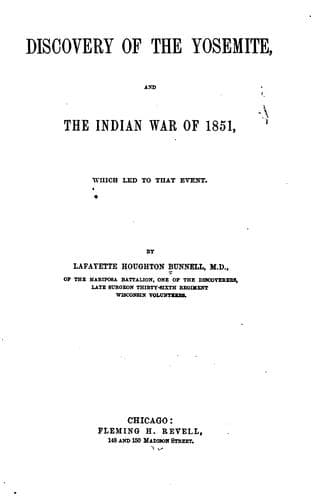
Discovery of the Yosemite, and the Indian War of 1851, Which Led to That EventBunnell, Lafayette Houghton
History
Discovery of the Yosemite, and the Indian War of 1851, Which Led to That Event
Bunnell, Lafayette Houghton
Indians of North America -- California; Pacific Coast Indians, Wars with, 1847-1865; Yosemite Valley (Calif.)
From this time on to 1864, a few entered every season; but during
these times California had a _wonder_ and interest in its population
and their enterprises, greater than in any of its remarkable scenery.
Everything was at high pressure, and the affairs of business and the
war for the Union were all that could excite the common interest. In
1864, there were only 147 visitors, including men, women and children.
The action of Congress this year, in setting the Yosemite and big trees
apart from the public domain as national parks, attracted attention to
them. The publicity given to the valley by this act, was world-wide,
and since 1864 the number visiting it has steadily increased.
According to the _Mariposa Gazette_, an authentic record shows that in
the season of 1865 the number was 276, in 1866, 382, in 1867, 435, in
1868, 627, and increasing rapidly; in 1875 the number for that year
had reached about 3,000. The figures are deemed reliable, as they were
obtained from the records of toll-roads and hotels. They are believed
to be very nearly correct.
The _Gazette_ “estimates the proportion of eastern and European in
the total number to be at least nine-tenths,” and says: “It is safe
to place the Atlantic and European visitors for the next ten years at
2,000 per annum.”
I have no doubt the number has been greater even than was estimated,
for improved facilities for entering the valley have since been
established. Seven principal _routes_ have been opened, and a post
office, telegraph and express offices located. A large hotel has been
built by the State, the trails have been purchased and made free, and
the management is now said by travelers to be quite good. There is no
reason why still further improvements should not be made. A branch
railroad from the San Joaquin Valley could enter the Yosemite by way of
the South Fork, or by the Valley of the Merced river. Mineral ores and
valuable lumber outside and below the valley and grant, would pay the
cost of construction, and no defacement of the grand old park or its
additions would be required, nor should be allowed.
With cars entering the valley, thousands of tourists of moderate wealth
would visit it; and then on foot, from the hotels, be able to see most
of the sublime scenery of the mountains.
If horses or carriages should be desired, for the more distant points
of interest, they may readily be obtained in the valley at reasonable
rates. At present, the expense of travel by stage, carriage and
horseback, is considerable, and many visiting California, do not feel
able to incur the extra expense of a visit to the Yosemite.
Visitors intending to see both the big trees and the Yosemite Valley,
should visit the trees first, as otherwise the forest monarchs will
have lost a large share of their interest and novelty.
Public-domain text, read in full here on John Shaqi.
Reviews
Reviews
No reviews yet
Be the first to share your thoughts on this work.
Elsewhere in the archive
Join the Discussion
Join the discussion
Sign in to leave a comment or review.
Sign InorCreate an account