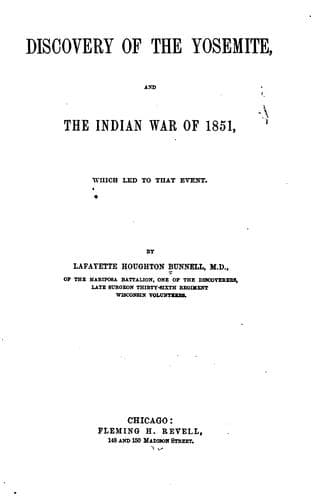
Discovery of the Yosemite, and the Indian War of 1851, Which Led to That EventBunnell, Lafayette Houghton
History
Discovery of the Yosemite, and the Indian War of 1851, Which Led to That Event
Bunnell, Lafayette Houghton
Indians of North America -- California; Pacific Coast Indians, Wars with, 1847-1865; Yosemite Valley (Calif.)
The raisins grown and cured in California are said to be equal to the
best Malaga; while the oranges, lemons, olives, figs, almonds, filberts
and English walnuts, command the highest prices in the market. Peaches,
pears, grapes and honey, are already large items in her trade; and her
wheat crops now reach a bulk that is simply enormous.
The grade of horses, cattle, swine, sheep and wool, are being brought
to a high degree of perfection; for the climate is most salubrious and
invigorating. Her gifts of nature are most bountiful and perfect. No
wonder, then, that the Californian is enthusiastic when speaking of his
sublime scenery, salubrious climate and surprising products.
But I must no longer dwell upon my theme, nor tell of the fruitful
Fresno lands, redeemed from savage barbarity. Those scenes of beauteous
enchantment I leave to those who may remain to enjoy them. And yet--
El Capitan, I turn to gaze upon thy lofty brow,
With reverent yearnings to thy Maker bow.
But now farewell, Yosemite;
If thou appears not again in sight,
Thou’lt come, I know, in life’s extremity
While passing into realms of light.
THE END.
FOOTNOTES:
[1] “Rock Chief,” a literal translation of “Tote-ack-ah-noo-la,”
rendered “El Capitan” in Spanish, from the likeness of a man’s head
upon the wall.
[2] The Yosemites were known as the “Bear tribe.” “Ten-ie-ya” was chief.
[3] “Scho look” is the Indian name for the “High Fall;” “Ah-wah-ne,”
the _old_ name of Valley, and “Kay o pha” (the sky), the name of
highest or snow-clad peaks.
[4] At intervals at the Vernal a _round_ rainbow is formed, perfect as
a finger-ring.
[5] “Glacier Fall,” in place of “Too-loo lo-we ack.”
[6] “Sentinel Dome” was known to the discoverers as the “South Dome,”
and “Tis sa ack,” meaning cleft-rock, as the “Half Dome.”
[7] Mr. Pratt’s retraction has finally appeared in the June number for
1891.
[8] An Indian corruption of Bautista.
[9] According to the Rev. S. G. Wright, of Leach Lake, Minnesota
Reservation, and “_Wain-ding_” (the source of the wind), the best
interpreters of the Chippewa perhaps now living, but few, if any, of
the Chippewa names for our lakes and rivers have been preserved in
their purity.
[10] Captain Joe Walker, for whom “Walker’s Pass” is named, told me
that he once passed quite near the valley on one of his mountain trips;
but that his Ute and Mono guides gave such a dismal account of the
canons of both rivers, that he kept his course near to the divide until
reaching Bull Creek, he descended and went into camp, not seeing the
valley proper.
[11] In some way unaccountable to me, this speech appears in my article
in Hutching’s work, as if delivered before the fight at “Battle
Mountain.”
[12] I have learned through the kindness of Dr. A. Kellogg, of the
California Academy of Sciences, that this tree is now known as the
“_Torreya Californica_.”
Public-domain text, read in full here on John Shaqi.
Reviews
Reviews
No reviews yet
Be the first to share your thoughts on this work.
Elsewhere in the archive
Join the Discussion
Join the discussion
Sign in to leave a comment or review.
Sign InorCreate an account