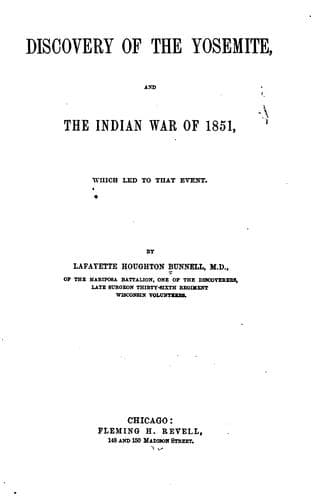
Discovery of the Yosemite, and the Indian War of 1851, Which Led to That EventBunnell, Lafayette Houghton
History
Discovery of the Yosemite, and the Indian War of 1851, Which Led to That Event
Bunnell, Lafayette Houghton
Indians of North America -- California; Pacific Coast Indians, Wars with, 1847-1865; Yosemite Valley (Calif.)
I afterwards learned the traditional history of Ten-ie-ya’s ancestors.
His statement was to the effect, that the Ah-wah-ne-chees had many
years ago been a large tribe, and lived in territory now claimed by
him and his people. That by wars, and a fatal black-sickness (probably
smallpox or measles), nearly all had been destroyed. The survivors
of the band fled from the valley and joined other tribes. For years
afterward, the country was uninhabited; but few of the extinct tribe
ever visited it, and from a superstitions fear, it was avoided. Some of
his ancestors had gone to the Mono tribe and been adopted by them. His
father had taken a wife from that tribe. His mother was a Mono woman,
and he had lived with her people while young. Eventually, Ten-ie-ya,
with some of his father’s tribe had visited the valley, and claimed it
as their birth-right. He thus became the founder of the new tribe or
band, which has since been called the “Yosemite.”
It is very probable that the statement of Major Savage, as to the
origin of the name as applicable to Ten-ie-ya’s band; was traditional
with his informants, but I give credit to Ten-ie-ya’s own history of
his tribe as most probable.
From my knowledge of Indian customs, I am aware that it is not uncommon
for them to change the names of persons or localities after some
remarkable event in the history of either. It would not, therefore,
appear strange that Ten-ie-ya should have adopted another name for
his band. I was unable to fix upon any definite date at which the
Ah-wah-ne-chees became extinct as a tribe, but from the fact that some
of the Yosemites claimed to be direct descendants, the time could not
have been as long as would be inferred from their descriptions. When
these facts were communicated to Captain Boling, and Ah-wah-ne was
ascertained to be the _classical_ name, the Captain said that name
was all right enough for history or poetry, but that we could not
now change the name Yosemite, nor was it desirable to do so. I made
every effort to ascertain the signification of Ah-wah-ne, but could
never fully satisfy myself, as I received different interpretations
at different times. In endeavoring to ascertain from Ten-ie-ya his
explanation of the name, he, by the motion of his hands, indicated
depth, while trying to illustrate the name, at the same time plucking
grass which he held up before me. From these “_signs_” I inferred that
it must mean the deep grassy valley. Still, it may not mean that.
Sandino was unable to give its true signification, saying by way of
explanation that Ah-wah-ne was a name of the old tribe, that he did
not know how to translate. Major Savage also said that Ten-ie-ya and a
few of the old Indians in his band used words which he did not fully
understand, and which the others could neither use nor explain.
The dialect of the Yosemites was a composite of that of almost every
tribe around them; and even words of Spanish derivation were discovered
in their conversations.
Public-domain text, read in full here on John Shaqi.
Reviews
Reviews
No reviews yet
Be the first to share your thoughts on this work.
Elsewhere in the archive
Join the Discussion
Join the discussion
Sign in to leave a comment or review.
Sign InorCreate an account