Discovery of the Yosemite, and the Indian War of 1851, Which Led to That EventBunnell, Lafayette Houghton
History
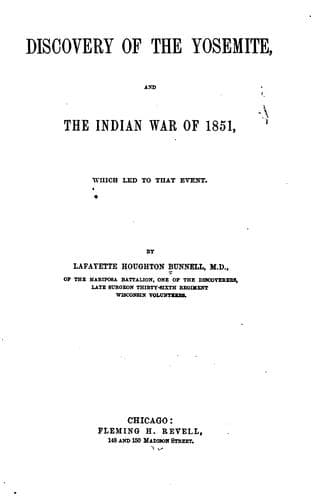
Discovery of the Yosemite, and the Indian War of 1851, Which Led to That Event
Bunnell, Lafayette Houghton
Indians of North America -- California; Pacific Coast Indians, Wars with, 1847-1865; Yosemite Valley (Calif.)
It is not uncommon for the mountain men and traders, to acquire a mixed
jargon of Indian dialects, which they mingle with Spanish, French or
English in their talk to an extent sometimes amusing. The Indians
readily adopt words from this lingo, and learn to Anglicize Indian
names in conversation with “Americans.” This, when done by the Mission
Indians, who perhaps have already made efforts to improve the Indian
name with Mission Spanish, tends to mislead the inquirer after _“pure”
Indian names_.
The Mission Indians after deserting, introduced and applied Spanish
names to objects that already had Indian designations, and in this way,
new words are formed from corrupted Mission Spanish, that may lead to
wrong interpretations. I learned from Russio, the chief interpreter,
that sometimes more than one word was used to express the same object,
and often one word expressed different objects. As an illustration of
corrupted Spanish that passes for Indian, the words Oya (olla) and
Hoya, may be taken. Oya signifies a water pot, and Hoya, a pit hole.
From these words the Mission Indians have formed “Loya,” which is used
to designate camp grounds where holes in the rocks may be found near,
in which to pulverize acorns, grass seeds, &c., as well as to the
“Sentinel Rock,” from its fancied resemblance to a water pot, or long
water _basket_. Another source of difficulty, is that of representing
by written characters the echoing gutteral sounds of some Indian words.
While being aware of this, I can safely assert that Yosemite, is purer
and better Indian than is Mississippi, (“Me-ze-se-be,” the river that
runs every where; that is, “Endless river”) or many other names that
are regarded as good if not _pure Indian_.[9]
Our interpreters were, or had been, Mission Indians, who rendered
the dialects into as good Spanish as they had at command, but rather
than fail in their office, for want of words, they would occasionally
insert one of their own coining. This was done, regardless of the
consequences, and when chided, declared it was for our benefit they had
done so.
Attempts were made to supersede the name we had given the valley, by
substituting some fancied improvements. At first, I supposed these to
be simply changes rung on Yosemite, but soon observed the earnestness
of the sponsors in advocating the new names, in their magazine and
newspaper articles. They claimed to have acquired the _correct name_
from their Indian guides, employed on their visits to the Yosemite.
In 1855 Mr. J. M. Hutchings, of San Francisco, visited the Yosemite,
and published a description of it, and also published a lithograph of
the Yosemite Fall. Through his energetic efforts, the valley was more
fully advertised. He ambitiously gave it the name of Yo-Hamite, and
tenaciously adhered to it for some time; though Yosemite had already
crystalized.
Public-domain text, read in full here on John Shaqi.
Reviews
Reviews
No reviews yet
Be the first to share your thoughts on this work.
Elsewhere in the archive
Join the Discussion
Join the discussion
Sign in to leave a comment or review.
Sign InorCreate an account