Discovery of the Yosemite, and the Indian War of 1851, Which Led to That EventBunnell, Lafayette Houghton
History
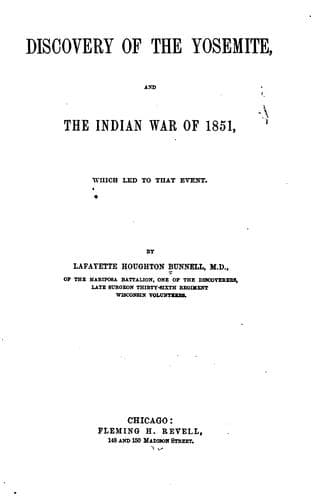
Discovery of the Yosemite, and the Indian War of 1851, Which Led to That Event
Bunnell, Lafayette Houghton
Indians of North America -- California; Pacific Coast Indians, Wars with, 1847-1865; Yosemite Valley (Calif.)
It was through the influence of this old friend of his father that
Ten-ie-ya was induced to leave the Mono tribe, and with a few of
the descendants from the Ah-wah-nee-chees, who had been living with
the Monos and Pai-Utes, to establish himself in the valley of his
ancestors as their chief. He was joined by the descendants from the
Ah-wah-ne-chees, and by others who had fled from their own tribes to
avoid summary Indian justice. The old “medicine man” was the counselor
of the young chief. Not long before the death of this patriarch, as
if endowed with prophetic wisdom, he assured Ten-ie-ya that while he
retained possession of Ah-wah-ne his band would increase in numbers
and become powerful. That if he befriended those who sought his
protection, no other tribe would come to the valley to make war upon
him, or attempt to drive him from it, and if he obeyed his counsels he
would put a spell upon it that would hold it sacred for him and his
people alone; none other would ever dare to make it their home. He then
cautioned the young chief against the horsemen of the lowlands (the
Spanish residents), and declared that, should they enter Ah-wah-ne, his
tribe would soon be scattered and destroyed, or his people be taken
captive, and he himself be the last chief in Ah-wah-ne.
For this reason, Ten-ie-ya declared, had he so rigidly guarded his
valley home, and all who sought his protection. No one ventured to
enter it, except by his permission; all feared the “witches” there, and
his displeasure. He had “made war upon the white gold diggers to drive
them from the mountains, and prevent their entrance into Ah-wah-ne.”
The Yo-sem-i-tes had been the most warlike of the mountain tribes in
this part of California; and the Ah-wah-ne-chee and Mono members of
it, were of finer build and lighter color than those commonly called
“California Digger Indians.” Even the “Diggers” of the band, from
association and the better food and air afforded in the mountains, had
become superior to their inheritance, and as a tribe, the Yosemites
were feared by other Indians.
The superstitious fear of annihilation had, however, so depressed the
warlike ardor of Ten-ie-ya, who had now become an old man, that he
had decided to make efforts to conciliate the Americans, rather than
further resist their occupancy of the mountains; as thereby, he hoped
to save his valley from intrusion. In spite of Ten-ie-ya’s cunning,
the prophecies of the “old medicine” man have been mostly fulfilled.
White horsemen have entered Ah-wah-ne; the tribe has been scattered and
destroyed. Ten-ie-ya was the last chief of his people. He was killed by
the chief of the Monos, not because of the prophecy; nor yet because of
our entrance into his territory, but in retribution for a crime against
the Mono’s hospitality. But I must not, Indian like, tell the latter
part of my story first.
Public-domain text, read in full here on John Shaqi.
Reviews
Reviews
No reviews yet
Be the first to share your thoughts on this work.
Elsewhere in the archive
Join the Discussion
Join the discussion
Sign in to leave a comment or review.
Sign InorCreate an account