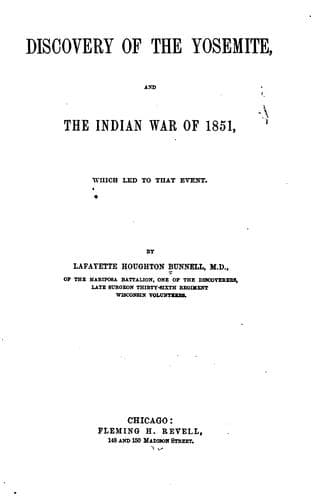
Discovery of the Yosemite, and the Indian War of 1851, Which Led to That EventBunnell, Lafayette Houghton
History
Discovery of the Yosemite, and the Indian War of 1851, Which Led to That Event
Bunnell, Lafayette Houghton
Indians of North America -- California; Pacific Coast Indians, Wars with, 1847-1865; Yosemite Valley (Calif.)
No better or braver man rode with our battalion. His popularity was
an appreciation of his true merit. On this occasion he was conscious
of the responsibility of his position, and, for a moment his modesty
overcame him. Although his _speech_ lacked the ready flow of language,
it eloquently expressed to his men the feelings of their Captain, and
we comprehended what he designed to say.[11] A short ride brought us
in sight of the main river. As we drew near to it a party of about one
hundred Indians were discovered drawn up as if to give us battle, but
we soon found their line had been established on the _opposite_ side of
the stream! while the swelling torrent between us seemed impassable.
Our scouts discovered a bark rope stretched across the river, just
above the mouth of the South Fork, which had been quite recently used.
Their scouts had undoubtedly discovered our rapid approach, and in
their haste to report the fact, had neglected to remove this rope, by
means of which, the crossing was made. The Indians of Northern climes
are equally expert in crossing streams. In winter, they sprinkle
sand upon the smooth ice, in order to cross their unshod ponies. The
discovery of the rope being reported to Captain Boling, he proposed to
utilize it by establishing a temporary ferry of logs. On examination,
the rope was found to be too slender to be of practical use, but was
employed to convey across a stronger one, made from our picket ropes or
“riatas,” tied together and twisted.
Two of our best swimmers crossed the river above the narrows, and
pulled our rope across by means of the bark one. To protect the men on
the opposite side, Captain Middleton, Joel H. Brooks, John Kenzie and
a few other expert riflemen, stood guard over them. A float was made
of dry logs while the rope was being placed in position, and this was
attached to the one across the stream by means of a rude pulley made
from the crotch of a convenient sapling. By this rude contrivance, we
crossed to and fro without accident. The horses and baggage were left
on the right bank in charge of a small but select camp guard. As we
commenced the ascent of the steep acclivity to the table above, where
we had seen the Indians apparently awaiting our approach, great care
was taken to keep open order. We momentarily expected to receive the
fire of the enemy. The hill-side was densely covered with brush, and
we cautiously threaded our march up through it, until we emerged into
the open ground at the crest of the hill. Here, not an Indian was in
sight to welcome or threaten our arrival. They had probably fled as
soon as they witnessed our crossing. Captain Boling felt disappointed;
but immediately sent out an advance skirmish line, while we moved in
closer order upon the village in sight, which we afterwards found to
be that of Jose Rey. Arrived there, we found it forsaken. This village
was beautifully situated upon an elevated table lying between the South
Fork and the main river.
Public-domain text, read in full here on John Shaqi.
Reviews
Reviews
No reviews yet
Be the first to share your thoughts on this work.
Elsewhere in the archive
Join the Discussion
Join the discussion
Sign in to leave a comment or review.
Sign InorCreate an account