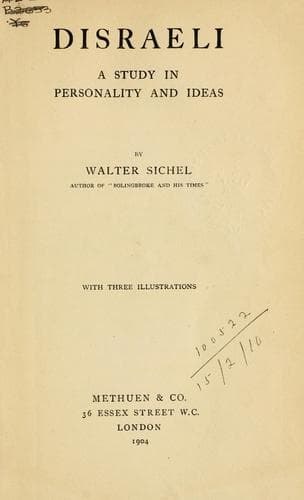
Disraeli: A Study in Personality and IdeasSichel, Walter
History
Disraeli: A Study in Personality and Ideas
Sichel, Walter
Disraeli, Benjamin, 1804-1881
And I can tell you this, gentlemen, from personal conversation
with some of the most intelligent of the labouring class, that ...
the hereditary, the traditionary policy of the Tory party that would
improve the condition of the people, is more appreciated by the people
than the ineffable mysteries and all the pains and penalties of the
Ballot Bill.... Is that wonderful? Consider the condition of the great
body of the working classes of this country. They are in possession of
personal privileges--of personal rights and liberties--which are not
enjoyed by the aristocracies of other countries. Recently they have
obtained--and wisely obtained--a great extension of political rights;
and when the people of England see that under the Constitution of this
country ... they possess every personal right of freedom, and according
to the conviction of the whole country, also an adequate concession
of political rights, is it at all wonderful that they should wish to
elevate and improve their condition, and is it unreasonable that they
should ask the Legislature to assist them in that behest, as far as it
is consistent with the general welfare of the realm?...”
The crucial problem still exacts, though it need not baffle, solution.
We are still waiting for the complete answer to the question here
propounded by Disraeli.
CHAPTER IV
CHURCH AND THEOCRACY
“The equality of man,” exclaims Disraeli in _Tancred_, “can only be
accomplished by the sovereignty of God. The longing for fraternity can
never be satisfied but under the sway of a common Father ... announce
the sublime and solacing principle of theocratic equality.”
This is a Semitic idea; but, then, so is the Church. The State, on the
other hand, is an Aryan conception. The real religion both of Athens
and of Rome was the State. These radical ideas of Church and State,
to which we have grown so accustomed, are, in fact, the products of
special races and the salvage of the centuries. The Romans invented
“Empire,” the Athenians “Democracy,” the Jews created “Theocracy.”
It may be interesting to inquire how this idea of a spiritual
_Church_--a colony from the unseen and eternal--has been in constant
conflict with that other dominant idea of the _State_; and how, among
the nations, England alone has made any serious or successful attempt
to reconcile them. For these are the ideas, expressed or implied, of
Disraeli. I take the liberty of illustrating these ideas afresh in my
own manner, and in continuous commentary, rather than by considering
isolated passages scattered through his books and speeches, many of
which I shall quote later on. And the standpoint marked by the title
of this chapter is the point of view which seems to me to distinguish
the many varieties of the theme which he presents, and which evidently
fascinated him.
Public-domain text, read in full here on John Shaqi.
Reviews
Reviews
No reviews yet
Be the first to share your thoughts on this work.
Elsewhere in the archive
Join the Discussion
Join the discussion
Sign in to leave a comment or review.
Sign InorCreate an account