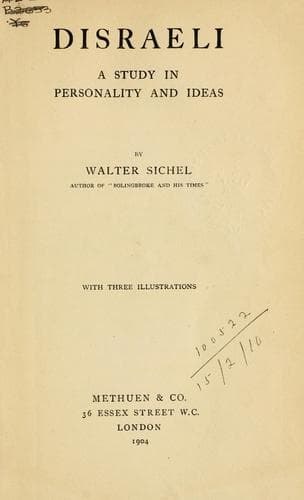
Disraeli: A Study in Personality and IdeasSichel, Walter
History
Disraeli: A Study in Personality and Ideas
Sichel, Walter
Disraeli, Benjamin, 1804-1881
It may not be generally remembered that only two years after Disraeli
entered the House of Commons he delivered himself of a remarkable
speech in this connection. He was opposed, he said, at that time to
a strictly State system, for he was opposed to “paternal government,
which stamped out the sense of independence in man, and caused him
to rely upon others.” Society should be strong, and the State weak;
order should not be disturbed by national injustice, nor liberty by
popular outcry. “_It is always the State and never Society--always
machinery and never sympathy._” But though he did not change the
principles of his outlook, he came by experience very materially to
change his view of the machinery by which they were to be applied. He
detested the interferences of centralisation; but a doubled population
and the overgrowth of cities rendered State measures imperative, and
their absence a disgrace. In his Edinburgh speech, twenty-eight years
later, he thus handled this national need: “... Ever since I have been
in public life I have done everything I possibly could to promote
the cause of the education of the people generally. I have done so
because I always felt that with the limited population of this United
Kingdom, compared with the great imperial position which it occupies
with reference to other nations, it is not only our duty, but ... an
absolute necessity, _that we should study to make every man the most
effective being that education can possibly constitute him_. In the
old wars there used to be a story that one Englishman could beat three
members of some other nation. But _I think if we want to maintain our
power, we ought to make one Englishman equal really in the business of
life to three other men that any other nation can furnish_. I do not
see otherwise how ... we can fulfil the great destiny that I believe
awaits us, and the great position we occupy.”
It will be noticed that he forecasts the practical and technical
requirements which, at a period of comparative commercial decline, we
are only now beginning to take to heart.
“Therefore,” he resumed, “so far as I am concerned, whether it be a far
greater advanced system of primary education--whether it be that system
of competitive examination which I have ever supported, though I am not
unconscious of some pedantry with which it is associated--or whatever
may be the circumstances, I shall ever be its supporter.”
Public-domain text, read in full here on John Shaqi.
Reviews
Reviews
No reviews yet
Be the first to share your thoughts on this work.
Elsewhere in the archive
Join the Discussion
Join the discussion
Sign in to leave a comment or review.
Sign InorCreate an account