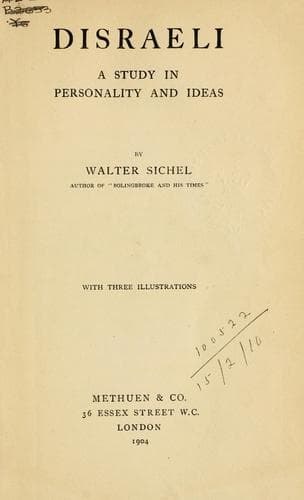
Disraeli: A Study in Personality and IdeasSichel, Walter
History
Disraeli: A Study in Personality and Ideas
Sichel, Walter
Disraeli, Benjamin, 1804-1881
proved powerful buffers against Russian predominance; and Russia still
sways the mongrel Bessarabia then restored to her. It is now recognised
that Russia, to traverse Persia, would encounter a British bayonet at
every step. Disraeli’s great object, like Palmerston’s, was to prevent
Turkey from becoming a fief to Russia, and the Black Sea from remaining
a mere Russian lake, as the repudiation by Mr. Gladstone, in 1871,
of the clause in the Treaty of Paris, for which the Crimean War had
been resumed, subsequently empowered it to become. Turkey, Disraeli
had written in _The Press_ of May 21, 1853, was “a necessary evil in
the European system,” but one preferable to some others, and more
likely to prevent general anarchy and bloodshed. And he recalled Prince
Potemkin’s old inscription on the gates of Chusan: “This is the road
to Constantinople.” The standing danger was the interposal of Russian
ambition on the perpetual plea of a Christian protectorate--resented
by many of the Christian provinces themselves--in order to constitute
Turkey a Russian province, and to spread a dominion less fanatical,
perhaps, but even more merciless and repressive in Europe, however
civilising it has proved in portions of Central Asia. His scheme,
compassing autonomy here, independence there, compactness, the power
to govern and the accountability to improve, everywhere was one of
development. It held within it, as he said, the seeds of “Evolution.”
* * * * *
How did Disraeli diagnose Russia’s legitimate aspirations? He certainly
neither ignored nor condemned them, but he distinguished between
aspirations legitimate and illegitimate. Speaking in 1871, after Russia
had violated and Mr. Gladstone had torn up the Black Sea Clause,
Disraeli criticised the course which the Ministry had pursued.
Public-domain text, read in full here on John Shaqi.
Reviews
Reviews
No reviews yet
Be the first to share your thoughts on this work.
Elsewhere in the archive
Join the Discussion
Join the discussion
Sign in to leave a comment or review.
Sign InorCreate an account