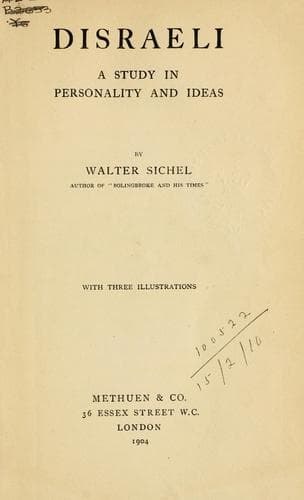
Disraeli: A Study in Personality and IdeasSichel, Walter
History
Disraeli: A Study in Personality and Ideas
Sichel, Walter
Disraeli, Benjamin, 1804-1881
What he realised and first proclaimed, was that America was ceasing
to be a mongrel blend or a colonial people, and was fast becoming
a national community, with a voice, a vigour, a tendency, and in
every department a twang, so to say, of its own; that, moreover,
this consolidation would tend towards empire, and that England must
prepare for and reckon with it, especially as a partial crudeness and
rudeness are to some extent inseparable from developments so sudden.
It had not always been thus. Even long after the Puritan settlement,
the primæval charm of an aboriginal race clung to its forests and
prairies. The strain, the science of race, fascinated Disraeli;
the unsubdued and the untameable ever appealed to him. Races could
only be replaced by nations; and the interval was always atomic and
confused; but it was also one of primitive dash and daring. As a youth,
Disraeli, in _Contarini_, had dreamed of such a life. In _Venetia_[136]
he had wondered whether the Atlantic would ever be so memorable as
the Mediterranean; whether pushfulness would ever attain refinement;
whether its provincialism might not be doomed to weakness. “... Its
civilisation will be more rapid, but will it be ... as permanent?...
What America is deficient in is creative intelligence. _It has no
nationality._ Its intelligence has been imported like its manufactured
goods. _Its inhabitants are a people, but are they a nation?_ I wish
that the empire of the Incas and the kingdom of Montezuma had not been
sacrificed. I wish that the republic of the Puritans had blended with
the tribes of the Wilderness.”
Two dangers for England, however, emanated from America; and perhaps
they were connected. The one was American Anglophobia, the other
Fenianism. The one might estrange our North American colonies; the
other was to imperil our national unity.
In 1865, Disraeli addressed himself to the former. The American war
was not then decided. He was not of opinion that, when it ended, our
connection with Canada would bring us into collision with America.
He did not believe that if the North was vanquished, it would “feel
inclined to enter immediately into another struggle with a power not
inferior in determination and in resources to the Southern States of
America;” and he saw many rocks ahead to divert the advancing tide--
“I form that opinion because I believe that the people of the United
States are eminently a sagacious people. I don’t think they are
insensible to the glory of great dominion and extended empire, and I
give them equally credit for being influenced by passions which actuate
mankind, and particularly nations which enjoy such freedom as they do.
But ... I do not think they would seize the moment of exhaustion as
being the most favourable for the prosecution of an enterprise which
would require great resources and great exertions.”
Public-domain text, read in full here on John Shaqi.
Reviews
Reviews
No reviews yet
Be the first to share your thoughts on this work.
Elsewhere in the archive
Join the Discussion
Join the discussion
Sign in to leave a comment or review.
Sign InorCreate an account