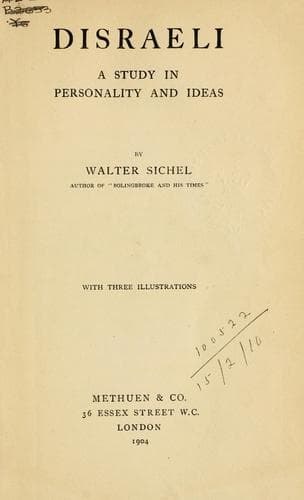
Disraeli: A Study in Personality and IdeasSichel, Walter
History
Disraeli: A Study in Personality and Ideas
Sichel, Walter
Disraeli, Benjamin, 1804-1881
The society of those days still retained much of the Regency’s tinsel.
It glittered far more than it shone. Society was not then quite
the Dresden china shop with porcelain figures of beaux and boxers,
of topers and bull-dogs, of satyrs and nymphs, of city swains and
simpering shepherdesses, that it had been ten or fifteen years before.
Byron, with his savage sincerity, may be said to have dashed that
smooth farrago to fragments. But it remained a society of veneer and
affectation. It was a less natural age than our own, with fewer ideals
and less outward movement. It was a more boisterous age than our own;
public opinion exercised far less pressure. It was at once a coarser,
a more sentimental and a more romantic, if a more bombastic age than
ours. There still lingered the curiosity of Dr. Johnson’s age for the
tittle-tattle of voyagers and the curiosities of barbarism. But it was
not in the main a more material age, or, under the surface, a much
more selfish one. Sympathy was local then. “The people were only half
born.” It was, however, certainly a generation far more fastidious and
exclusive; and at the same time it was certainly more appreciative
of genius. You could then appeal to the few where you cannot now
appeal to the many; for the few then had neither the narrowness of the
_bourgeoisie_ nor the unlimited appetite of the million.
“The invention,” smiles Disraeli so early as in his mock-classical
squib, _The Infernal Marriage_, “by Jupiter of an aristocratic
immortality, as a reward for a well-spent life on earth, appears to
me to have been a very ingenious idea. It really is a reward very
stimulative of good conduct before we shuffle off this mortal coil, and
remarkably contrasts with the democracy of the damned. The Elysians,
with a splendid climate, a teeming soil, and a nation made on purpose
to wait upon them, of course enjoyed themselves very much.... The
Elysians, indeed, being highly refined and gifted ... were naturally a
very liberal-minded race and very capable of appreciating every kind of
excellence. If a gnome, or a sylph, therefore, in any way distinguished
themselves, ... aye! indeed, if the poor devils could do nothing better
than write a poem or a novel, they were sure to be noticed by the
Elysians, who always bowed to them as they passed by, and sometimes,
indeed, even admitted them into their circles.”
Public-domain text, read in full here on John Shaqi.
Reviews
Reviews
No reviews yet
Be the first to share your thoughts on this work.
Elsewhere in the archive
Join the Discussion
Join the discussion
Sign in to leave a comment or review.
Sign InorCreate an account