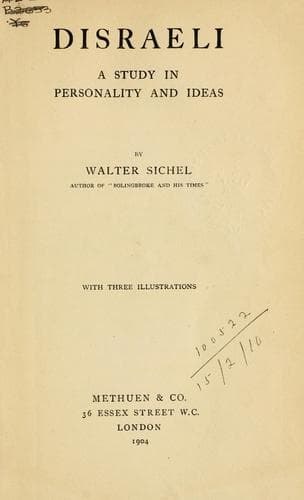
Disraeli: A Study in Personality and IdeasSichel, Walter
History
Disraeli: A Study in Personality and Ideas
Sichel, Walter
Disraeli, Benjamin, 1804-1881
He felt all along that, after all, true society is at home, and not
with “polished ruffians;” the “courtesy of the heart” was preferable
to that “of the head.” “My idea of perfect society,” says “Lothair,”
“is being married, as I propose, and paying visits to Brentham;” or, as
Disraeli varies the theme in the same novel, “I am fond of society that
pleases me, that is accomplished and natural and ingenious; otherwise I
prefer being alone.” Home, he thought, should be the centre of society,
and a homeless society was not one at all. It is very noticeable, in
comparing present with past fiction, how the English sense of home and
flicker of the fireside, which used to warm every page, has receded
out of view before the motor-speed and nervous restlessness of the
age. His home-fondness was touchingly displayed after the death of his
wife by his reply to a friend, who asked if he were driving home--a
reply accompanied by tears; “Home! I have no home _now_.” Nor did any
great man ever reserve the sanctities of the hearth more completely
from a prying public. The purity of his home affections was one of Mr.
Gladstone’s notes of eulogy in the funeral oration that he delivered
in the House to which Disraeli had been proudly devoted for forty-five
long years. There are scores of sayings and episodes in his books, from
_Vivian Grey_ downwards, regarding the home affections; many charming
touches, too, in his letters to his sister. But I content myself with
one, from _Venetia_--
“... After all, we have no friends that we can depend upon in this life
but our parents.... All other intimacies, however ardent, are liable
to cool; all other confidence, however limited, to be violated. In
the phantasmagoria of life, the friend with whom we have cultivated
mutual trust for years is often suddenly or gradually estranged from
us, or becomes, from painful yet irresistible circumstances, even
our deadliest foe. As for women ... the mistresses of our hearts,
who has not learnt that the links of passion are fragile as they are
glittering?... Where is the enamoured face that smiled upon our early
love, and was to shed tears over our grave?... No wonder we grow
callous, for how few have the opportunity of returning to the hearth
which they quitted in levity or thoughtless weariness, yet which alone
is faithful to them; whose sweet affections require not the stimulus
of prosperity or fame, the lure of accomplishments or the tribute of
flattery, but which are constant to us in distress, and console us even
in disgrace!”
I ought, perhaps, to add a word of Disraeli’s ideas on love and
marriage. No one set more store by, or laid more store on, the deciding
influence of woman on man’s career. No one recognised more heartily a
woman’s instinctive superiority to logic. How good is the humour in
that dressing-room scene of the ’seventies in _Lothair_:--
Public-domain text, read in full here on John Shaqi.
Reviews
Reviews
No reviews yet
Be the first to share your thoughts on this work.
Elsewhere in the archive
Join the Discussion
Join the discussion
Sign in to leave a comment or review.
Sign InorCreate an account