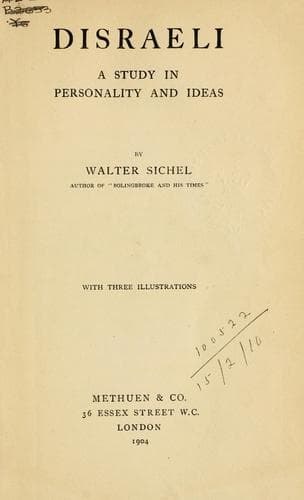
Disraeli: A Study in Personality and IdeasSichel, Walter
History
Disraeli: A Study in Personality and Ideas
Sichel, Walter
Disraeli, Benjamin, 1804-1881
inspiration of the spirit of the age;” the men of the ’seventies who
“played with billiard-balls games that were not billiards,” and the
lady of the ’forties who “sacrificed even her lovers to her friends;”
stolid bores, our “Social Polyphemi;” books, “the curse of the human
race;” of Austria, “two things made her a nation, she was German
and she was a Catholic, and now she is neither;” of the Reform Bill,
“It gave to Manchester a bishop and to Birmingham a dandy.” And,
less familiar, there is “Lord Squib’s” definition of money value,
“very dear;” “Count Mirabel’s” pleasantry, “coffee and confidence;”
“Essper George’s,” “Like all great travellers, I have seen more than I
remember, and remembered more than I have seen;” Venus, the “goddess
of watering-places,” and “Burlington” with “his old loves and new
dances.” There is the advice in _The Young Duke_, too, that “good
fortune with good management, no country house and no children, is
Aladdin’s lamp,” and that in _Lothair_ to “go into the country for the
first note of the nightingale and return to town for the first muffin
bell.” Then there is the “treatise on a subject in which everybody
is interested, in a style no one understands;” and there are the
French actresses averring at supper, “No language makes you so thirsty
as French;” the English tradesmen who “console themselves for not
getting their bills paid by inviting their customers to dinner;” the
Utilitarian, whose dogma was “Rules are general, feelings are general,
and property should be general;” and the definition of Liberty, “Do
as others do, and never knock men down.” There is Monmouth’s “some
woman has got hold of him and made him a Whig.” There is the great
political lady “who liked handsome people, even handsome women;” and
there is the unfortunate third-rate statesman, “who committed suicide
from a want of imagination.” Nor should I omit an unprinted _mot_. He
defined a political “Deputation” as “a noun of multitude meaning many,
but not signifying much.” He was wont also to distinguish between
“lawyers” and “legislators.” A brace of very witty similes also
claim a mention here--the comparison of the Parliament-built region
of Harley Square to “a large family of plain children with Portland
Place and Portman Square for their respectable parents;” and that of
the detached breakfast-tables at “Brentham,” to “a cluster of Greek
or Italian Republics, instead of a great metropolitan table, like a
central government, absorbing all the genius and resources of society.”
Further, in the same category are the many metaphorical allusions and
descriptions that ornament his speeches. The transference of the
Bank currency crisis to the Neapolitan procession and miracle of St.
Januarius, both from a common cause, “congealed circulation;” the
picture of a maladroit reinforcement of opposition as the exploit of
the Turkish Admiral, summoned by the Sultan and blessed by the muftis,
Public-domain text, read in full here on John Shaqi.
Reviews
Reviews
No reviews yet
Be the first to share your thoughts on this work.
Elsewhere in the archive
Join the Discussion
Join the discussion
Sign in to leave a comment or review.
Sign InorCreate an account