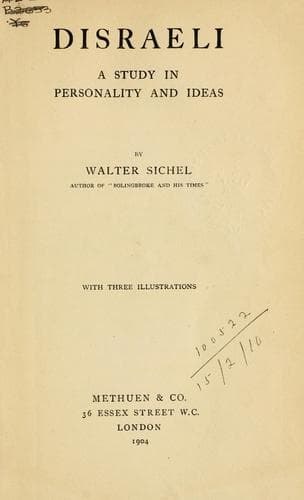
Disraeli: A Study in Personality and IdeasSichel, Walter
History
Disraeli: A Study in Personality and Ideas
Sichel, Walter
Disraeli, Benjamin, 1804-1881
The preparation for career--apart from its entitling endowments--should
be education; but education, he held, even in its prescientific days,
often started with a vital mistake. It proceeded on words, grammars,
and systems. It should proceed on a knowledge of predisposition; others
should know a man before he is called upon to know himself. “What we
want is to discover the character of a man at his birth, and _found his
education upon his nature_.... All is an affair of organisation....
Among men there are some points of similarity and sympathy. There
are few alike; there are some totally unlike the mass.... Until we
know more of ourselves, of what use are our systems?... We speculate
upon the character of man; we divide and we subdivide. We have our
generals, our sages, our statesmen. There is not a modification of
mind that is not mapped out in our great atlas of intelligence. We
cannot be wrong, because we have mapped out the past; and we are
famous for discovering the future when it has taken place. Napoleon
is First Consul, and would found a dynasty.... But what use is the
discovery, when the Consul is already tearing off his republican robe
and snatching the imperial diadem? And suppose, which has happened, and
may and will happen again--suppose a being of a different organisation
from Napoleon or Cromwell placed in the same situation--a being gifted
with a combination of intelligence hitherto unknown--where, then,
is our moral philosophy? How are we to speculate upon results which
are to be produced by unknown causes?... The whole system of moral
philosophy is a delusion, fit only for the play of sophists in an age
of physiological ignorance.” So, too, he had reason to think of some
physicians “who decide by precedents which have no resemblance, and
never busy themselves about the idiosyncrasies of their patients.”[182]
“Until,” he wrote again, “men are educated with reference to their
nature, there will be no end of domestic fracas.” He remembered his
grandfather’s misconstruction of his father’s temperament, and his
uncle’s of his own. Even illness he considered “as much a part of
necessary education as travel or study.” And his constant idea, that
national literature ought to be native and not imported, allied itself
to his educational ideas also. “The duty of education is to give ideas.
When our limited intelligence was confined to the literature of two
dead languages, it was necessary to acquire them.... But now each
nation has its literature.... Let education, then, be confined to the
national literature, and we should soon perceive the beneficial effects
upon the mind of the student. Study would then be a profitable delight.
I pity the poor Gothic victim of the grammar and the lexicon. The
Greeks, who were masters of composition, were ignorant of all languages
but their own. They concentrated the genius of the study of expression
upon one tongue. _To this they owe that blended simplicity and strength
Public-domain text, read in full here on John Shaqi.
Reviews
Reviews
No reviews yet
Be the first to share your thoughts on this work.
Elsewhere in the archive
Join the Discussion
Join the discussion
Sign in to leave a comment or review.
Sign InorCreate an account