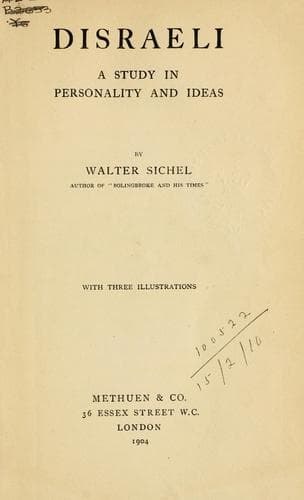
Disraeli: A Study in Personality and IdeasSichel, Walter
History
Disraeli: A Study in Personality and Ideas
Sichel, Walter
Disraeli, Benjamin, 1804-1881
When he died, amid national mourning, the late Lord Salisbury, after
singling out his unquenchable zeal for the glory of Britain, lasting
to a period when “the gratification of every possible desire negatived
the presumption of any inferior motive,” adverted to his “patience, his
gentleness, his unswerving and unselfish loyalty to his colleagues and
fellow-labourers.” Indisputably his moral character was high. Without
question he, like Gladstone, raised the tone of parliamentary life
from that of the days when politics were merely a squabble for place
and a toss-up as to “whether England should be ruled by Tory nobles
or by Whig.” His tone may not always have chimed with certain forms
or formulas of earnestness, but he acted up to his own high standard.
“It was impossible,” said the late Lord Granville, “to deny that Lord
Beaconsfield had played a great part in British History. No one could
deny his rare and splendid gifts and his force of character.” Character
will always appeal to England. “But,” pursued the orator, after
noticing his tolerance and forbearance, “he undoubtedly possessed the
power of appealing to the imagination, not only of his countrymen, but
of foreigners,[188] and that power is not destroyed by death.”
My book opened with Personality, Ideas, and Imagination. With
Imagination, Ideas, and Personality it shall close. They can turn and
change the semblances of material “facts,” for they abide behind the
veil of time and of existence.
FOOTNOTES
[1] “... These are concessionary, not Conservative principles. This
party treats institutions as we do our pheasants, they preserve only to
destroy them.”
[2] Swift, adverting to National Debt.
[3] Cardinal Newman afterwards inveighed against the same union of
faithlessness and Mammon in one of his finest sermons. Disraeli
constantly dwelt on the dangers that liberty might suffer, if a
democracy unreconciled to monarchy and its institutions became a
class instead of an element, and was brought into collision with the
“three per cents.” The despotisms of bare democracy and of aggravated
plutocracy were equally distasteful to him, and he feared their union.
_Cf._ many striking passages in _The Press_, 1853-59.
[4] With this passage should be compared the striking remarks on p. 222
of _The Political Biography of Lord George Bentinck_.
[5] “It was that noble ambition, the highest and the best, that must
be born in the heart and organised in the brain, which will not let
a man be content unless his intellectual power is recognised by his
race, and desires that it should contribute to their welfare.” Thus he
speaks of _Coningsby_, the castle of whose fathers is not to be one “of
Indolence.”
[6] Through Lord Durham, Lord J. Russell, and Lord Melbourne, whom he
met early at Mrs. Norton’s.
Public-domain text, read in full here on John Shaqi.
Reviews
Reviews
No reviews yet
Be the first to share your thoughts on this work.
Elsewhere in the archive
Join the Discussion
Join the discussion
Sign in to leave a comment or review.
Sign InorCreate an account