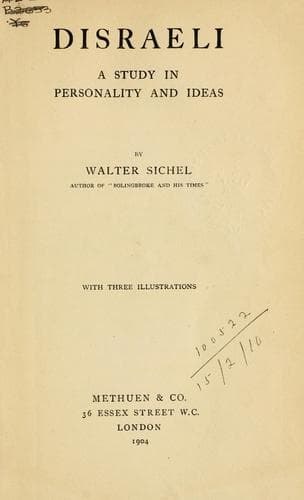
Disraeli: A Study in Personality and IdeasSichel, Walter
History
Disraeli: A Study in Personality and Ideas
Sichel, Walter
Disraeli, Benjamin, 1804-1881
[129] In 1878, Disraeli, after emphasising the Sultan’s friendliness to
Greece and the value of a Græco-Turk _entente_ as a bar to “Pan-Slavic
monopoly,” said: “... No prince, probably, that has ever lived has
gone through such a series of catastrophes. One of his predecessors
commits suicide; his immediate predecessor is subject to a visitation
even more awful. The moment he ascends the throne, his ministers are
assassinated. A conspiracy breaks out in his own palace, and then he
learns that his kingdom is invaded, ... and that his enemy is at his
gates; yet with all these trials, ... he has never swerved in ... the
feeling of a desire to deal with Greece in a spirit of friendship....
He is apparently a man whose ... impulses are good, ... and where
impulses are good, there is always hope.”
[130] _Cf._ his _Life of Lord George Bentinck_, p. 170.
[131] This was the speech in which Disraeli styled himself as not only
a devoted parliamentarian, but “a gentleman of the Press.”
[132] Disraeli always maintained that the expulsion of Louis Philippe
was the act of the secret societies, and not that of the French nation.
He had reason to know. His letters in 1848 are full of gloom regarding
the outlook in Europe. So were Carlyle’s.
[133] _Life of Lord George Bentinck_ (1852).
[134] “... The end of their system ... is the glory of the empire and
the prosperity of the people.”
[135] Disraeli was always careful to distinguish between
“revolution”--a permanent upheaval, and “insurrection”--a transitory
outburst. Thus he expressly terms the continental movements of 1848,
“insurrections.”
[136] Though published in 1836, it was written considerably earlier.
[137] Explaining, in 1835, his phrase that “the Whigs had grasped the
bloody hand of O’Connell,” Disraeli said: “I mean that they had formed
an alliance with one whose policy was hostile to the preservation of
the country, who threatens us with a dismemberment of the empire, which
cannot take place without a civil war.”
[138] _Cf._ the “passionate carelessness” in “the old state of affairs”
of “this experimental chapter in our history” in the speech of March,
1869. On the “Maynooth Grant” question, also, he observed, in 1846,
that the boons offered to the Roman Catholics were, that “two should
sleep in a bed instead of three.”
[139] Eight years before, Disraeli had written in the trenchant
slap-dash of his _Runnymede Letters_: “... Then, Ireland must be
tranquillised. So I think. Feed the poor and hang the agitators. That
will do it. But that’s not your way. It is the _destruction_ of the
English and Protestant interest that is the Whig specific for Irish
tranquillity.”
[140] He was alluding to Lord Derby’s earlier efforts. And again, in
another speech: “... The principles of our policy were, first, to
create and not destroy; and, secondly, to acknowledge that you could
not in any more effectual way strengthen the Protestant interest than
by doing justice to the Roman Catholics.”
Public-domain text, read in full here on John Shaqi.
Reviews
Reviews
No reviews yet
Be the first to share your thoughts on this work.
Elsewhere in the archive
Join the Discussion
Join the discussion
Sign in to leave a comment or review.
Sign InorCreate an account