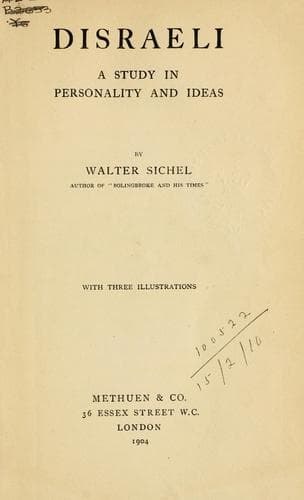
Disraeli: A Study in Personality and IdeasSichel, Walter
History
Disraeli: A Study in Personality and Ideas
Sichel, Walter
Disraeli, Benjamin, 1804-1881
Are the modern ideas of untempered democracy--Carlyle’s “despair of
finding any heroes to govern you”--compatible with real representation,
as contrasted with the mechanism of elective systems or the shams of
paper constitutions? Can these ideas ever prove expressive of true
nationality--the _character_ of a united people--as opposed to the
conflicting instincts of unreconciled races, or the factious claims of
divergent groups? Is not the mechanical subordination to the “State”
of Socialism hostile to an individual “nationality”? How, in the
ferment of modern progress, can the new wine be prevented from bursting
the old bottles? How can government and free action, independence
and inter-dependence, be allied in living reality? How can opinion
be organised into allegiance to leadership? How can traditions be
rendered less formal? How can discipline and development, authority
and elasticity, combine? How can the machinery of national custom be
brought into real accord with popular aspirations, and the mainstay of
character with the modern speed of movement? “Certainly,” as Carlyle
insisted, “it is the hugest question ever heretofore propounded to
mankind.”
In the proem to the _Revolutionary Epick_, Disraeli says that the
French Revolution marks the greatest political crisis since the Siege
of Troy. The paroxysm of that Revolution produced two hollow fictions,
the “Rights of Man” and “the Sovereignty of the People.”
Before illustrating the train of Disraeli’s ideas, let me touch on
these two doctrines.
_The Rights of Man._ What is the real meaning of a dogma which
annihilates the duties of citizens in declaring the licence of their
“rights;” in affirming personal claims as distinguished from popular
or legal privileges; in destroying the community by exalting the person?
It was based on Rousseau’s figment of a “Return to Nature.”
All “Returns to Nature” are, if we reflect, a harking back to chaos,
a denial of the whole self-developing social state which God has
ordained for man. They are the protests of instinct against order, of
“the People” against “the Nation,” of isolation against fusion, of
“naturalism” against “spiritualism.” One way or the other, they signify
relapses into brute force and animal conflict.
Public-domain text, read in full here on John Shaqi.
Reviews
Reviews
No reviews yet
Be the first to share your thoughts on this work.
Join the Discussion
Join the discussion
Sign in to leave a comment or review.
Sign InorCreate an account