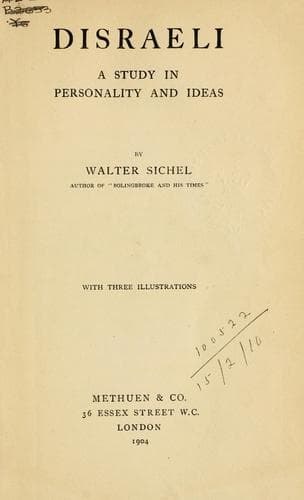
Disraeli: A Study in Personality and IdeasSichel, Walter
History
Disraeli: A Study in Personality and Ideas
Sichel, Walter
Disraeli, Benjamin, 1804-1881
“The People” is a phrase of physiology, not of politics. It is an
abstruse name for a multitude; it ignores temperament and will.
Stripped of its high sound, its “Sovereignty” means government by
miscellany, the censorship of the census. Its political bearings are
as purely arithmetical as are the corresponding ethical bearings
of the Utilitarian creed; for they both disregard the many-sided
nature of man. Although derived from the speculations of some late
seventeenth-century republicans in England, the French application of
the theory--Burke’s “Wisdom told by the Head”--was entirely new. It
was not republicanism, the government by qualified members of ordered
classes: it was a despotism by the crowd as crowd. Such a “Democracy”
has never been the permanent scheme of government in any nation,
although “Liberal opinion” has relied too often on its simplicity.
“One man, one vote,” quantity instead of quality is in truth no
principle at all; and this attempt to confuse the Book of Wisdom with
the Book of Numbers is a feat reserved for modern periods alone. All
earlier systems of democracy were more or less discriminate, for no
indiscriminate state can cohere, and both freedom and order are based
on discrimination. The Attic Democracy demanded a degraded class of
unleisured, unemancipated slaves. The American Republic, which has
freed serfs and abolished leisure, possesses a peculiar stability,
which will outwear its occasional corruption because it exists through
a landed democracy--one impossible in overcrowded Europe--as we shall
find Disraeli emphasising in my American chapter.
In a word, the logical outcome of the “Sovereignty of the People”
is the tyranny of plebiscite. But a “plebiscite” dispenses with the
very principle of representation, for where all decide equally, why
should any be represented? Political power exercisable by _all_ can
only arise when all are sufficiently qualified. But it is always the
_some_, never the _all_, who are competent. Even in their proper sphere
of merely personal choice, how false and fatal most plebiscites have
proved!--“Not this man, but Barabbas.”
_Vox populi_ is only _vox Dei_ through the gradual institutions that
nations create; not through the wayward moods and momentary clamours of
“the people.” The whole problem is how at once to range and to raise
public opinion--the popular conscience; how to preserve moral, without
retarding material, progress; how to inspire “progress” itself with the
conviction that it consists in following the highest leadership; how,
again, to ensure such leadership by the constant association of duty
with privilege, and responsibility with power; how to recruit it by
every means that the spread of enlightenment can furnish.
“On man alone the fate of man is placed,”
sang Disraeli, in the _Revolutionary Epick_; and of “opinion”--
“Physical strength and moral were united,
And I, the pledge of their true love was born.”
Public-domain text, read in full here on John Shaqi.
Reviews
Reviews
No reviews yet
Be the first to share your thoughts on this work.
Elsewhere in the archive
Join the Discussion
Join the discussion
Sign in to leave a comment or review.
Sign InorCreate an account