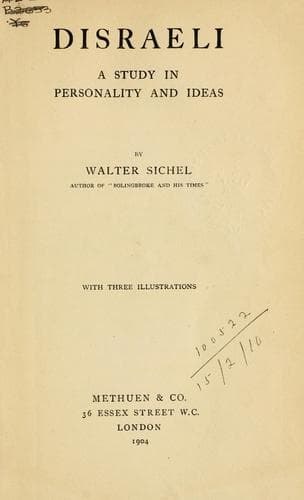
Disraeli: A Study in Personality and IdeasSichel, Walter
History
Disraeli: A Study in Personality and Ideas
Sichel, Walter
Disraeli, Benjamin, 1804-1881
But for this purpose the national imagination must be reckoned with.
“... When that faculty is astir in a nation,” he has insisted, “it will
sacrifice even physical comfort to follow its impulses.” The struggle
will always continue for national unity, but it takes generations to
perceive that colonial federation, for example, is as requisite a
means to this idea as native institutions representing real elements.
“... A political institution is a machine; the motive power is the
national character,” says “Sidonia;” “Society in this country is
perplexed, almost paralysed. How are the elements of the nation to be
again blended together? In what spirit is that reorganisation to take
place?...”
And again, so late as 1870, in the preface to _Lothair_, summarising
his works, Disraeli observes: “... National institutions were the
ramparts of the multitude against large estates exercising political
power derived from a limited class. The Church was in theory--and
once it had been in practice--the spiritual and intellectual trainer
of the people. The privileges of the multitude and the prerogatives
of the sovereign had grown up together, and together they had waned.
Under the plea of Liberalism, all the institutions which were the
bulwarks of the multitude had been sapped and weakened, and nothing
had been substituted for them. The people were without education, and,
relatively to the advance of science and the comfort of the superior
classes, their condition had deteriorated, and their physical quality
as a race was threatened....”
On the other hand, the incongruity of modern political machinery was
never far from Disraeli’s thoughts. “... Whatever may have been the
faults of the ancient governments,” he muses in _Contarini Fleming_,
“they were in closer relation to the times, the countries, and to the
governed, than ours. The ancients invented their governments according
to their wants. The moderns have adopted foreign policies, and then
modelled their conduct upon this borrowed regulation. This circumstance
has occasioned our manners and our customs to be so confused and absurd
and unphilosophical.... He who profoundly meditates upon the situation
of modern Europe, will also discover how productive of misery has been
the senseless adoption of Oriental customs by Northern peoples....” And
Disraeli also distinguished between the direct democracy of multitude
and that of “popular” institutions.
Nothing is less truly “popular” than “the people” as a “democracy,”
for the despotism of many is as odious as the arbitrary will of one,
and even more fatal than the government by groups of the few. This
is the distinction on which he expatiated in a famous speech of 1847
at Aylesbury, where he contrasted “popular principles” with “Liberal
opinions”--
Public-domain text, read in full here on John Shaqi.
Reviews
Reviews
No reviews yet
Be the first to share your thoughts on this work.
Elsewhere in the archive
Join the Discussion
Join the discussion
Sign in to leave a comment or review.
Sign InorCreate an account