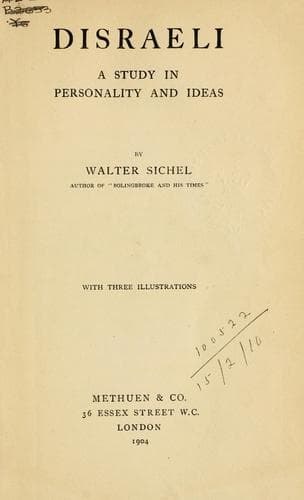
Disraeli: A Study in Personality and IdeasSichel, Walter
History
Disraeli: A Study in Personality and Ideas
Sichel, Walter
Disraeli, Benjamin, 1804-1881
denationalising tendencies, its certainty of some social and physical
demoralisation, as well as the possible changes in European competition
which might necessitate another “commercial and social revolution,” he
inveighed against the inference that “we are to be rescued from the
alleged power of one class, only to fall under the avowed dominion of
another;” he believed that “the monarchy of England, its sovereign
power mitigated by the acknowledged authority of the estates of the
realm, has its root in the hearts of the people, and is capable of
securing the happiness of the nation and the power of the State.” His
peroration--some of which I shall give in the next chapter--is a noble
flight of hope. He discerned at once that the transformation scene
of 1846 would affect society more than politics, and that the next
extension of the franchise must consequently prove a social antidote as
well as a social sedative.
In 1839, refuting Mr. Hume’s hobby already alluded to, he showed
that the theory is nowhere inherent in our Constitution, but is a
doctrinaire supplement of alien origin; that the “Commons” are a
political order invested with power for the performance of duties,
just as the Peers are a similar order, but needing no representation;
he re-urged that the House of Commons was the representative of
the “nation”--an organic whole, and not of the “people”--a vague
abstraction. He had even then already pointed out that, historically,
the delegates before the Restoration had perverted the national
traditions by announcing, more than a century before the French
Revolution, the sovereignty of the “people.” He once more stoutly
denied that “taxation and representation went hand-in-hand” according
to our constitution. There was representation without election, as
in the case of the Church in the Lords, for the Crown appointed the
bishops, not the clergy. And as regards taxation, it was indirect, as
well as, unfortunately, direct. In the same year, protesting against
Lord John Russell’s assumption of a “monarchy of the middle classes,”
Disraeli repeated that in this country “the exercise of political
power must be associated with great public duties,” just as in 1846,
when justifying the burdens on land so long as protection was accorded
it, he asserted that great honours demand great burdens. Again, in
1848, Disraeli, opposing Mr. Hume once more, and protesting against the
finality of the reconstruction of 1832, even before Lord John Russell
declared the question free for both parties in 1853 and 1856--strongly
condemned the radical scheme just because it did not “... enable the
labouring classes to take their place in the Constitution of the
country.” “If there be any mistake,” he said, “more striking than
another in the settlement of 1832, ... it is, in my opinion, that the
bill of 1832 took the qualification of _property_ in too hard and rigid
a sense, as the only qualification which should exist in this country
Public-domain text, read in full here on John Shaqi.
Reviews
Reviews
No reviews yet
Be the first to share your thoughts on this work.
Elsewhere in the archive
Join the Discussion
Join the discussion
Sign in to leave a comment or review.
Sign InorCreate an account