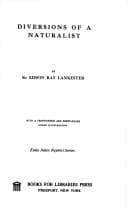
Diversions of a NaturalistLankester, E. Ray (Edwin Ray), Sir
History
Diversions of a Naturalist
Lankester, E. Ray (Edwin Ray), Sir
Natural history
In the following year I went early in June in search of another Alpine
delight, the spring flowers--not those of the highest "downs" and
sheltering rocks 8000 or 9000 feet above sea-level, but those of the
higher meadows, where the pine forests are beginning to thin out, and
rich crops are cut before July by the skilful workers of the great
Swiss industry, that of cow-herding and the production of cheese. It is
difficult to define properly the term "Alpine" as applied to flowers.
It is now used by horticulturists very generally for those exquisite
small plants, the Saxifrages, Androsacæ, Gentians, etc., which grow
in the highest regions to which plant-life extends--regions which are
often covered by the winter's snow until June, and even late into that
month. Some of these plants (as, for instance, the Soldanellas--those
little lilac-coloured flowers like pendent foolscaps which are allied
to our primrose--and the crocus and the butterbur (Petasites)) actually
blossom beneath the snow and push their open flowers through it to the
sunlight. Others of these "higher Alpines" have a peculiar mode of
growth related to their special conditions of life. Their stems are
very short and their foliage closely set, so that they form compact
tufts or cushions, on which their short-stalked brilliant little
flowers are dotted. The fact is they have not time in the short summer
of these high regions to grow long stems. Their flowers are produced
on low-lying parts of the plant, which carry small and abundant green
leaves, but never send up long leaf-bearing stems. Not only do they
thus do quickly, and without needless upward growth, what they have
to do--namely, expose green leaves to the sunlight for nutrition and
their flowers to the fertilizing visits of insects so as to ripen their
reproductive seeds--but they benefit by keeping close to the warmth of
the ground, which is heated by the strong sunshine, and is three and a
half degrees higher in temperature than the cold moist air. In similar
positions in low-lying regions the difference between the temperature
of the air and that of the surface of the ground is not as much as one
degree.
Public-domain text, read in full here on John Shaqi.
Reviews
Reviews
No reviews yet
Be the first to share your thoughts on this work.
Elsewhere in the archive
Join the Discussion
Join the discussion
Sign in to leave a comment or review.
Sign InorCreate an account