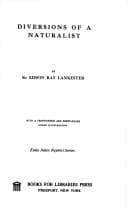
Diversions of a NaturalistLankester, E. Ray (Edwin Ray), Sir
History
Diversions of a Naturalist
Lankester, E. Ray (Edwin Ray), Sir
Natural history
individuals not presenting that advantageous peculiarity of variation.
CHAPTER XIX
SCIENCE AND DANCING
THERE is at the present day in this country a real and most happy
revival of interest in the great art of dancing as exhibited on the
stage. We owe this to the creative ability of the musical composers
and directors of the Russian Imperial Ballet, as well as to the
highly-trained and gifted Russian artists who have visited this
country, and especially to the poetical genius of Madame Anna Pavlova.
Though dancing may seem, on first thought, a subject remote from
science, yet, like all other human developments, it is a matter for
scientific investigation, and one upon which science can throw much
light. What is the origin and essential nature of "dancing"? Do animals
dance? What is its early history in mankind? What is its relation not
merely historically, but from the point of view of psychology--the
study of the mind--to other arts? What is its real "value" and possible
achievement?
To dance is to trip with measured steps, and, whilst primarily
referring to human movement, the word is secondarily applied to
rapid rhythmic movements even of inanimate objects. Rhythm is what
distinguishes dancing from ordinary movement of progression or from
simple gesture or mere antics. Dancing on the part of man or animal
implies a sense of rhythm. Though not common amongst animals, it is
exhibited by many birds, by spiders, and by some crustaceans! Rhythm is
an essential feature of the sequence of sounds which we call "music."
The singing of birds is related to their perception of and pleasure
in rhythm, and it is not, therefore, surprising that they should also
dance. It is, however, curious that the birds which "dance" are not
the "singing birds," and that there are many birds which neither sing
nor dance. The dancing of birds is usually part of the "display" of
the males for the purpose of attracting the females at the breeding
season. It is well known in some African cranes, as well as in rails
and other similar birds, and may be witnessed at the Zoological Gardens
in London. Other birds "strut" rather than dance, whilst displaying
their plumage, as, for instance, the turkey and pheasant tribe and
the bustards. Parrots and cockatoos will often make a rhythmical
up-and-down movement of the neck in time to music, but usually the
"dance" is the accompaniment of definite emotion. The male spider of
some species courts the female by making dancing movements and posing
itself in a very curious way, so as to display a spot of bright colour
on the head to her observation. The same kind of movement and action
has been observed in marine shrimp-like creatures. Some spiders are
excited and made to dance by the vibrating note of a tuning-fork set
going near them. I once had the chance to observe a male octopus in
the aquarium at Naples, who was displaying himself to the female,
changing colour rapidly from one shade to another, and rolling his
Public-domain text, read in full here on John Shaqi.
Reviews
Reviews
No reviews yet
Be the first to share your thoughts on this work.
Elsewhere in the archive
Join the Discussion
Join the discussion
Sign in to leave a comment or review.
Sign InorCreate an account