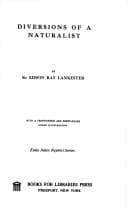
Diversions of a NaturalistLankester, E. Ray (Edwin Ray), Sir
History
Diversions of a Naturalist
Lankester, E. Ray (Edwin Ray), Sir
Natural history
Man has more and more, as he has advanced in mental growth, rejected
the unreasoning instinctive classes of action, and substituted for them
action based on his own experience and conscious memory, action which
is the result of education--not the education of the school, but that
of life in all its variety. But in many things he is still entirely
guided by unreasoning mechanical instinct, and in others he is partly
impelled by the old inherited instinct, partly restrained and guided by
reason based on experience and memory. This makes the comparison of the
courting man with the courting animal doubly interesting. We ought to
distinguish what he is doing as a result of ancient inherited mechanism
from what he is doing as a result of conscious observation, memory, and
reasoning.
CHAPTER XXI
COURTSHIP IN ANIMALS AND MAN
THE German poet Schiller arrived long ago at the conclusion that the
machinery of the world is driven by hunger and by love. If we join with
hunger, which is the craving of the individual for nourishment, the
activities which aim at self-defence,--whether against competitors for
food, against would-be devourers, or against dangers to life and limb,
from storm, flood, and temperature,--we may accept Schiller's statement
as equivalent to this, namely, that the activities and the mechanisms
of living things are related to two great ends--the preservation of the
individual and the preservation of the race. "Love," or what we should
call in more discriminating language "amorousness," or the "mating
hunger," is the absolute and inherent attribute of living things upon
which the preservation of the race depends. The preservation of the
individual is of less importance in the scheme of Nature than the
preservation of the race, and we find that food-hunger and the risk of
dangers of all kinds to the continuance of an individual life are made
of no account when satisfaction of mate-hunger and the preservation
and perpetuation of the race requires the sacrifice or the shortening
of the life, or the permanent distortion or self-immolation of the
individual. Eccentric behaviour and strange exaggeration of form and
colour, as judged by the standard of preservation of the individual,
are found to be explained as due to structures (nervous or other)
implanted in the race by natural selection, because, and in consequence
of, the fact that they tend to the satisfaction of mate-hunger, and
consequently to the preservation of the race.
Public-domain text, read in full here on John Shaqi.
Reviews
Reviews
No reviews yet
Be the first to share your thoughts on this work.
Elsewhere in the archive
Join the Discussion
Join the discussion
Sign in to leave a comment or review.
Sign InorCreate an account