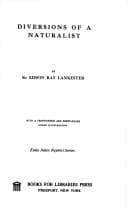
Diversions of a NaturalistLankester, E. Ray (Edwin Ray), Sir
History
Diversions of a Naturalist
Lankester, E. Ray (Edwin Ray), Sir
Natural history
Descartes and other philosophers have held that there is a great
difference in the mental processes of animals as compared with those of
man in this, namely, that man is "conscious," that is to say, conscious
of himself as "I," and, as it were, looks on at himself acting on and
being acted on by surrounding existences, whilst (so it is assumed)
animals have not this consciousness, but are "automata," going through
all the processes of life, and even behaving more or less as man does
in similar circumstances, yet without being "conscious." It is, no
doubt, true that many of the complicated actions of insects are carried
on without consciousness of the purpose or significance of what they
are doing. Such is the storing by certain wasps of smaller insects
in carefully-cut chambers, to serve as food for the wasp's young, to
be hatched from an egg to be laid in the "cold-storage chamber." The
mother wasp will go on doing this when she has had the hind part of
her body removed and has no eggs to lay. This mechanical unreasoning
behaviour in insects is without exception, so that we must accept M.
Fabre's conclusion that they are, in fact, unconscious "automata." I
have already referred to this subject in an earlier chapter, p. 197.
We at once place ourselves in difficulty in discussing this subject
by the use of the words "conscious" and "consciousness," for, as
so often happens, they are customarily applied in a vague and
uncertain way to the mental activities of man--without any precise
agreement as to what is meant by either of them. We are all agreed
that a rational human being may go through a series of elaborate
actions apparently directed by purpose and yet not be what we call
"conscious," that is to say, "aware" of what he is doing. This occurs
in "sleep-walking" and in "day-dreaming." And again, we know that a
man may be evidently conscious during a certain period, and yet forget
directly afterwards that he has been conscious and said and done
certain things during that period. This often happens after "concussion
of the brain." It is, as a matter of fact, uncertain whether one
ought to regard the condition of a man during that obliterated or
forgotten period of seeming consciousness as rightly to be described
by the term "conscious." And the reason why one has this doubt is
that we all recognize that consciousness without memory is really
a contradiction in terms. Memory--the inscription or record in our
brains of past experiences--exists without consciousness, as we all
know, by observation of ourselves and our fellows. But the very
essence of consciousness is memory. We cannot even be "conscious" of
the experience of a single moment without being also conscious of
the memory of some previous condition--however small, temporary, and
incomplete the memory may be. To be conscious we must _compare_ the
impressions reaching the brain at this moment with the memory of those
of a past moment. And in lower animals and infants beginning to be
Public-domain text, read in full here on John Shaqi.
Reviews
Reviews
No reviews yet
Be the first to share your thoughts on this work.
Elsewhere in the archive
Join the Discussion
Join the discussion
Sign in to leave a comment or review.
Sign InorCreate an account