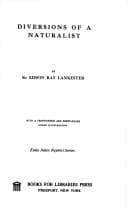
Diversions of a NaturalistLankester, E. Ray (Edwin Ray), Sir
History
Diversions of a Naturalist
Lankester, E. Ray (Edwin Ray), Sir
Natural history
There is no reason to doubt that consciousness--a beginning of
it--exists in such animals as dogs and monkeys. And it is equally true
that man not only exists for some months after he is born without being
"conscious," but for some years is so only in disconnected intervals.
As a matter of fact, he is very incompletely "conscious," even when
adult. He is quite unconscious of a great many of his elaborate
actions. He has, moreover, an "unconscious memory"--that is to say, a
memory of the existence of which he is not conscious--which guides
him to, and in, the most complicated proceedings, and astonishes
him when, by some chance, it is suddenly revealed to consciousness,
or is converted into "conscious memory," when he dreams. Every man
finds, sooner or later, that he has stored within him a register of
things, persons, and events of the existence of which he was totally
unaware. The gradual development of "consciousness" in higher ape-like
animals and lower men, in the course of ages, is not the unparalleled
thing which one is apt, at times, to consider it to be, since we can
all remember the dawning of our own consciousness and its gradual
development. We can also watch its growth in that most mysterious and
wonderful casket of ancestral secrets and unfathomable destiny--a human
infant.
Inscrutable as is the ultimate nature of "consciousness," we may put
its further consideration aside on the present occasion, since it
forms no actual barrier between men-like apes and ape-like men. On
the contrary, the higher apes, the lower living races of men and the
children of higher races, furnish us with evidence of transition from
the lower condition of automatism to the higher one of self-recognition
or consciousness in its most developed form. There is, however, a
leading difference in the mental organization and mental processes
of various animals, including man, which is of more importance in
the matter which we are considering, and is largely related to the
physical measurable difference in the size of the brain. The insects
of which Fabre says: "They know nothing about anything," inherit a
nervous mechanism--a brain and elongated mass of nerve-cells and
fibres, like our spinal cord--which works sharply and definitely like
a toy-automaton. Touch this part and that movement follows; excite the
sense of vision with this visible thing, and such and such a movement
of the limbs or jaws or other parts ensues. The stimulation of skin,
eye, ear, or nose conveys a "message" by nerves to the "brain," or
centre, and immediately by other nerves an "answer" is conveyed from
the brain or centre in the shape of an order to this and those muscles
to contract, the appropriate nerves being set at work and exciting the
related muscles to contraction. The number of possible excitations and
related responsive movements thus arranged is numerically very great
in many animals, but they are limited. They are inherited just as they
Public-domain text, read in full here on John Shaqi.
Reviews
Reviews
No reviews yet
Be the first to share your thoughts on this work.
Elsewhere in the archive
Join the Discussion
Join the discussion
Sign in to leave a comment or review.
Sign InorCreate an account