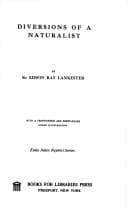
Diversions of a NaturalistLankester, E. Ray (Edwin Ray), Sir
History
Diversions of a Naturalist
Lankester, E. Ray (Edwin Ray), Sir
Natural history
that those who are feeding on "polished rice" can be prevented from
acquiring the disease "Berri-berri" by mixing rice "outsides" with the
polished rice. The study of the subject has gone further.
A crystallizable substance allied to proteids has been separated by the
chemist in quite minute quantity (one part by weight in 10,000 parts of
rice) from the outer coat of rice grain, and is called "vitamine." It
is this substance which prevents the "whole" rice grain from causing
"Berri-berri" in men and birds who feed on it, and it has been shown
experimentally that it prevents the development of "Berri-berri" when
taken with "polished rice," and cures it when administered to man or
bird suffering from that disease. This case calls to mind the popular
notion that the indigestion caused by eating a "peeled" raw cucumber
can be prevented by eating some of the dark-green "rind" or outside
of the cucumber. I do not know that anyone has ever shown that this
is a true doctrine, but it serves as an illustration of what has been
demonstrated in the case of rice grains and "Berri-berri." Here, then,
again we have, in the case of rice, a minute quantity of a substance
naturally present in an article of food when taken in its natural
normal condition, which is destroyed and removed by the ignorant
manipulation of man, although necessary and essential if that article
of food is to serve as healthy diet. In this case (as so many others)
it is the attempt of greedy traders to make money by giving to a
worthless spoilt article the appearance of the regular and valuable
article, which has led to disease and disaster. It becomes more and
more obvious that the selection of articles of food and the whole
question of what is a healthy diet, are not such simple things as is
often supposed. Here, as in everything we do, we must either keep to
the long-established habits sanctioned by Nature, or we must have full
and detailed knowledge to guide us in new ways, so that we shall not
recklessly blunder by ignorance into disaster and death. The "feeding"
of man and of his herds requires new and continued investigation. Old
convictions and traditions in these matters must not be lightly thrust
aside by the possessor of that little knowledge which is a dangerous
thing. Meanwhile, for the civilized man the advice of Pasteur's pupil
and successor, the late Professor Duclaux, is noteworthy: "Do not
eat much, but eat many things; there is safety in variety, danger in
uniformity."
Public-domain text, read in full here on John Shaqi.
Reviews
Reviews
No reviews yet
Be the first to share your thoughts on this work.
Elsewhere in the archive
Join the Discussion
Join the discussion
Sign in to leave a comment or review.
Sign InorCreate an account