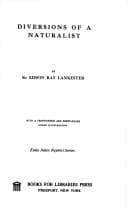
Diversions of a NaturalistLankester, E. Ray (Edwin Ray), Sir
History
Diversions of a Naturalist
Lankester, E. Ray (Edwin Ray), Sir
Natural history
But a single case like this does not bring one very far on the way
to deciding the question as to whether there are persons who are
genuinely and successfully guided to the discovery of subterranean
water by strange sensations and by spasmodic movements of their limbs
or of hazel-twigs held in the hands, due (as they declare) to an
obscure influence which emanates from subterranean water and from
buried metal. The fact is that we have in the belief in the guidance
of the douser by occult influences a troublesome case of the fallacy
in reasoning expressed by the words, "post hoc ergo propter hoc,"
or, to put it in English, "after this, therefore caused by this."
Primitive man found that this mode of forming a conclusion very often
led to a correct discovery of the connexion between two events, and he
adopted it as a ready method of guidance, although it was frequently
fallacious. It has taken ages, literally ages, to make people discard
this mode of arriving at a conclusion in serious matters, and it is
still usual in less vital affairs. To show that B followed upon the
occurrence of A, even once, is, of course, a proper and useful way of
forming a guess or a suggestion as to the cause of B, but still more
is your guess legitimate if the sequence has occurred several times
in your experience. But it is only a guess: a conclusion must not be
accepted on that basis, although lazy and hasty people do adopt such
conclusions. You must find out the details of the nature of A and also
of B, and if possible how the one is connected with the other. And if
you cannot do that you can still establish your conclusion and confirm
your guess by showing that B _invariably_ follows upon A, or that (in
a long experience) only when A has been present, and never when A has
not been present, has B occurred. If you cannot prove the truth of your
guess by this experimental demonstration of the exclusion of other
causes than A or by the experimental demonstration of the invariable
occurrence of B after A has occurred, then you have to seek for
evidence of a real connexion between A and B, though not an invariable
one, by collecting a vast number of instances of the occurrence of B
and finding out whether A has preceded it in such a large proportion
of cases (as compared with those in which B has occurred without the
previous occurrence of A) that the cases in which B follows A cannot be
considered as accidental, but indicate a real causal relation of A to B.
Public-domain text, read in full here on John Shaqi.
Reviews
Reviews
No reviews yet
Be the first to share your thoughts on this work.
Elsewhere in the archive
Join the Discussion
Join the discussion
Sign in to leave a comment or review.
Sign InorCreate an account