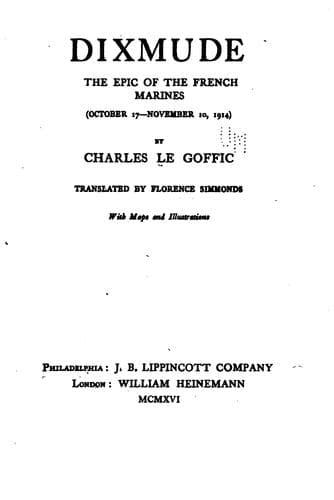
Dixmude: The epic of the French marines (October 17-November 10, 1914)Le Goffic, Charles
History
Dixmude: The epic of the French marines (October 17-November 10, 1914)
Le Goffic, Charles
France. Marine. Brigade des fusiliers marins; World War, 1914-1918 -- Campaigns -- Belgium; Yser, Battle of the, Belgium, 1914
A counter-attack ordered by the officer in command of the defence and
led by Lieutenant d'Albia had covered his escape. The eighth company, in
reserve, reinforced by a section of the fifth company of the 2nd
Regiment, under Commander Mauros and Lieutenant Daniel, entrenched
itself behind the barricade at the level crossing on the Eessen
road.[75] On all the roads leading to the Yser, and especially at the
three bridges, sections strongly established themselves or helped to
consolidate sections already there. Would these dispositions, hastily
taken by Commandant Delage, be enough to save Dixmude? At most they
could only prolong the agony. Her hours were numbered. After having
driven its way through the hostile column which had reached the Yser,
Lieutenant d'Albia's section encountered more Germans debouching from
the Grand' Place and neighbouring streets. Germans and Frenchmen now
formed nothing but a mass of shouting men. They shot each other at close
quarters; they fought with their bayonets, their knives, their clubbed
rifles, and when these were broken, with their fists, with their feet,
even with their teeth. By three in the afternoon we had lost one half of
our men, killed, wounded, or prisoners. The German columns were still
pouring into Dixmude through the breaches in the defence. They pushed us
back to the bridges, which we still held, which we were indeed to hold
to the end. They were going to take Dixmude, but the little sailor was
right: they were not going to pass the Yser. One more attack was
organised to bring off the Mauros company, which was retiring under a
terrible fire. The remains of several sections were brought together,
and, led by their officers, they charged into the _mêlée_ in the
streets. One purple-faced, sweating Marine, who had seen his brother
fall, swore he would have the blood of twenty Boches. He went for them
with the bayonet, counting "One! two! three!" etc., till he had reached
twenty-two. After that he returned to his company, a madman.
But what could the finest heroism do against the swarms of men who
rose, as it were, from the earth as fast as they were crushed? "They are
like bugs," sighed a quartermaster, and night was coming on. Dixmude had
ceased to give signs of life. For six hours fighting had gone on over a
dismembered corpse. Not a gable, not a wall, was left standing, except
those of the flour factory. To hold these heaps of rubbish, which might
turn into a focus of infection, was not worth the little finger of one
of our men. At 5 o'clock in the evening, after blowing up the bridges
and the flour factory, the Admiral retired behind the Yser.[76]
Public-domain text, read in full here on John Shaqi.
Reviews
Reviews
No reviews yet
Be the first to share your thoughts on this work.
Elsewhere in the archive
Join the Discussion
Join the discussion
Sign in to leave a comment or review.
Sign InorCreate an account