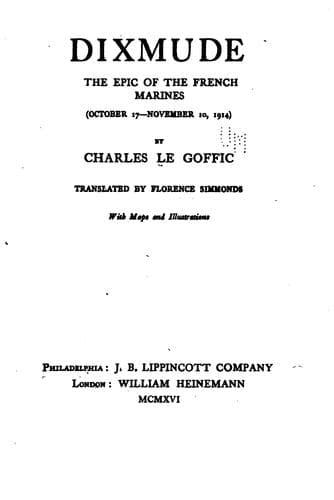
Dixmude: The epic of the French marines (October 17-November 10, 1914)Le Goffic, Charles
History
Dixmude: The epic of the French marines (October 17-November 10, 1914)
Le Goffic, Charles
France. Marine. Brigade des fusiliers marins; World War, 1914-1918 -- Campaigns -- Belgium; Yser, Battle of the, Belgium, 1914
[63] For the period between October 24 and November 6 the names of the
following officers who fell must be added to those already given: killed
or dead of their wounds, Lieutenants Cherdel and Richard,
Second-Lieutenants Rousset and Le Coq; among those wounded, but not
mortally, Lieutenants Antoine, "son of Admiral Antoine and the model of
a perfect officer" (private correspondence), and Revel, who, when
severely wounded in the thigh, ordered his decimated company to retire,
"leaving him in the trench where he had fallen."
[64] Marcotte de Sainte-Marie was provisionally succeeded at the head of
his battalion by Lieutenant Dordet, who acquitted himself admirably.
[65] And yet these cemetery trenches afforded comparative security.
Before reaching them it was necessary to cross a perfectly flat zone of
60 metres, continually swept by rifle fire and shrapnel. "This we passed
at the double, in Indian file, our knapsacks on our heads, and popped,
those who had not been left on the way, into the cellars under the
caretaker's house with an 'Ouf!' of relief." (Georges Delaballe.)
[66] It must be remembered that the Belgians had been fighting for three
solid months, and that until the 23rd October they had faced the Germans
alone, if not at Dixmude at least as far north as Nieuport.
[67] To say nothing of a captive balloon. "Violent bombardment of our
trenches, directed by 'sausage' balloons; feeble reply of French and
Belgian artillery," is the entry, under date of the 8th, in an officer's
note-book, where also we find under date of the 9th: "Bombardment
continued. Night attack on the outposts, which were driven in."
[68] Dr. Caradec says the German artillery, consisting of batteries of
105's and 77's, was posted 2,000 metres away, behind the Château of
Woumen, and near Vladsloo, Korteckeer, and Kasterthoeck.
[69] Before that, however, at half-past nine, a lively attack had been
directed against the front of the ninth and tenth companies of the 1st
Regiment, which occupied towards Beerst one end of the arc described
round Dixmude by our trenches; the extremities of this arc rested on the
Yser. The Germans tried to push between the Yser and the flank of the
ninth company. This attack was repulsed by the two companies, assisted
by fire from the remaining trenches and a battery of 75's.
[70] Rather above Dixmude station, between the railway embankment and
the Eessen road.
Public-domain text, read in full here on John Shaqi.
Reviews
Reviews
No reviews yet
Be the first to share your thoughts on this work.
Elsewhere in the archive
Join the Discussion
Join the discussion
Sign in to leave a comment or review.
Sign InorCreate an account