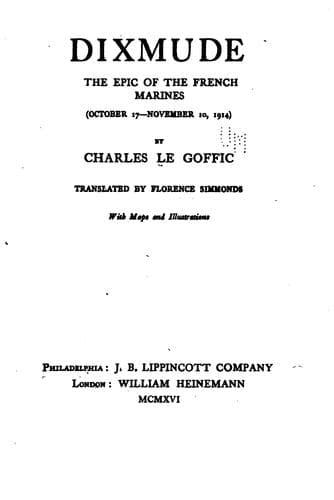
Dixmude: The epic of the French marines (October 17-November 10, 1914)Le Goffic, Charles
History
Dixmude: The epic of the French marines (October 17-November 10, 1914)
Le Goffic, Charles
France. Marine. Brigade des fusiliers marins; World War, 1914-1918 -- Campaigns -- Belgium; Yser, Battle of the, Belgium, 1914
[76] It has been said that an old woman caused the fall of Dixmude on
November 10. "The allied forces occupying Dixmude," said the _Daily
Mail_, "consisted of a squadron of cavalry encamped on the right bank of
the Yser, two batteries of 75's, a regiment of infantry, and a battalion
of Zouaves (!). The battle began with a violent cannonade, which had the
great distillery in the centre of the town as its principal objective.
Two of our 75's were on the first floor of a tannery, the others below,
on a little mound where skins were cleaned. Our artillery was able to
hold the enemy in check, opening great breaches through the hostile
ranks with its shells. One German gun lost all its team, and the Uhlans
were mown down by our sailors. Our men, cavalry and infantry, were
awaiting the word to attack. Just at this moment appeared an old woman
to whom our Zouaves had been kind, as she seemed so miserable. She had
marched with them, leaning on the arm of one and another and sharing
their soup. She mounted to the first floor of the tannery, and then
disappeared. A moment later a light appeared on the roof of the
distillery. It was seen to swing three times from right to left. Five
minutes later the German shells began to rain upon the point indicated
by the light. In a very short time the building was greatly damaged,
fires broke out, and the burning alcohol lighted up the whole
neighbourhood. Unable to stem either the deluge of shells or this
conflagration, the French general decided to evacuate the town and
entrench himself on the canal banks. With great difficulty the 75's were
withdrawn from their positions. Before quitting the city the French
soldiers saw, and were able to identify, the 'old woman,' stretched on
the ground, with the uniform of an Uhlan peeping from beneath 'her'
skirts." This is all pure imagination. Spies certainly played a part in
the fall of Dixmude. Too many people were accepted as refugees and
distressed inhabitants who were in reality the guides and accomplices of
the enemy. But, in the first place, we had no Zouaves at Dixmude;
secondly, our observation post was not in a tannery; finally, we had no
cavalry. The only body which barred the way to the Germans was the
Marines, omitted in this account.
Public-domain text, read in full here on John Shaqi.
Reviews
Reviews
No reviews yet
Be the first to share your thoughts on this work.
Elsewhere in the archive
Join the Discussion
Join the discussion
Sign in to leave a comment or review.
Sign InorCreate an account