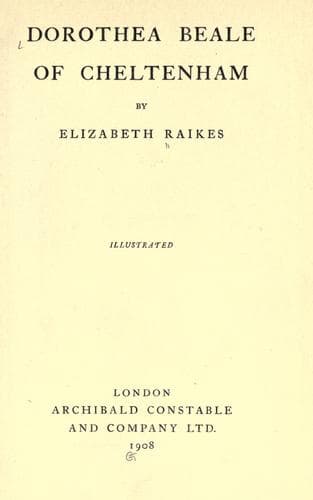
Beale, Dorothea, 1831-1906; Cheltenham Ladies' College -- History; Teachers -- England -- Biography
The Schools’ Inquiry Commission was instituted in 1864, a year in which
John Ruskin, in a lecture at Manchester, made a passionate appeal to rich
women to claim their right to serve—and reign. His cry did not reach
a larger public until, eight years later, the lecture was published
under the title ‘Of Queens’ Gardens’ in _Sesame and Lilies_. Like the
simultaneous discovery of some great star, by watchers strange to one
another and half a continent apart, the movement for enlarging the
scope of women’s work was furthered by men of divers ways and methods,
heralded by visionaries like Tennyson and Ruskin, marshalled into
deliberate order by high-hearted officials like the Secretary of the
Governesses’ Benevolent Society and the School Inspector Joshua Fitch.
Possibly no Assistant Commissioner, as he drew up his report, recalled
the ringing words of Ruskin. But though the medium varies to the stretch
of difference between the inspiration of a great poem and the deliberate
statements of a blue-book, we recognise the same force behind both, and
see both alike to be channels for one great stream of tendency. The
conclusions drawn from the report, the resulting effects seen in new
schools and organised public examinations, miss nothing of their special
value if regarded in connection with such words as these:—
‘Let a girl’s education be as serious as a boy’s. You bring up
your girls as if they were meant for side-board ornaments, and
then complain of their frivolity. Give them the same advantages
that you give their brothers ... teach _them_, also, that
courage and truth are the pillars of their being.... There is
hardly a girl’s school in this Christian Kingdom where the
children’s courage and sincerity would be thought of half
so much importance as their way of coming in at a door....
And give them, lastly, not only noble teachings, but noble
teachers.’[40]
The Schools’ Inquiry Commission was instituted to examine into the
existing state of education above the elementary grade, and to report
on measures needed for its improvement, having special regard to all
endowments applicable, or which could rightly be made applicable,
thereto. By the instance of Miss Emily Davies, girls’ schools were
included in the inquiry. Among the Commissioners was Lord Lyttelton,
who was regarded by those who wished to improve women’s education as a
friend to girls. He had manfully asserted their right to a share of the
endowments, and of women to a share in the management of girls’ schools.
Sir Stafford Northcote, Dr. Temple, and Mr. Forster were also members of
the Commission. Among the Assistant Commissioners, whose business it was
to visit and report upon schools, were such well-known names as those of
T. H. Green, J. G. Fitch, and J. Bryce.
Public-domain text, read in full here on John Shaqi.
Reviews
Reviews
No reviews yet
Be the first to share your thoughts on this work.
Elsewhere in the archive
Join the Discussion
Join the discussion
Sign in to leave a comment or review.
Sign InorCreate an account