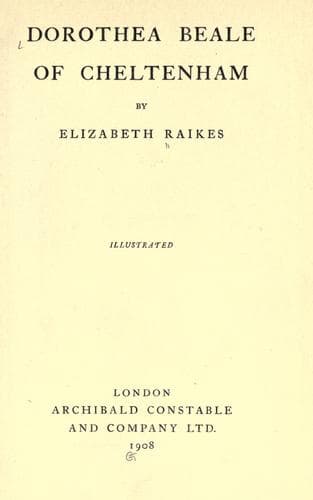
Beale, Dorothea, 1831-1906; Cheltenham Ladies' College -- History; Teachers -- England -- Biography
‘Examiners must be prepared not to domineer but to learn that
the art is yet in its infancy, and their knowledge of what
girls can or ought to do is at present very slight. They must
be ready to admit the possibility of a teacher knowing better
than his judges. The latter are sometimes tempted to exclaim,
_Quis custodiat ipsos custodes?_ If the school curriculum and
the examinations are so far out of harmony that a large amount
of special preparation is required, either the curriculum is
at fault or the examination an evil.... I know that some make
a great point of having the actual University examinations
opened, because a mere “women’s examination” is spoken of
contemptuously. I believe that in trying to avoid this, we
should encounter greater evils, and that the wish is connected
with a misplaced reverence which many women entertain for the
learning of a “pass man.”’
After some years of consideration a decision was practically forced upon
Miss Beale. She must choose for her clever girls either to pass a public
examination which she thought more suited for men, or to fall behind
in a path which was surely leading in the right direction. She did not
hesitate, but saw that on this, as on many occasions, it must be her part
to labour to remove obstructions, to overcome obstacles.
In her interview with the Commissioners, on being asked if she would
approve of the establishment of a special examination for ladies up to
the standard of attainment of the London matriculation, she had replied,
‘Certainly,’ but advocated that it should be made possible for women to
take German instead of Greek. This examination, she agreed, might be
taken as a measure, though the measure might not be filled with the same
subjects as for men. She was soon called upon to act in this matter, for
in 1869 it was opened to women, and the University of Cambridge also
instituted an examination for women over eighteen years of age.
Miss Beale accepted both for the College, but for some years there was
no regular organisation of work for those who were taking the Cambridge
examination. This was partly due to the higher limit of age. It was
then thought extraordinary that girls should stay at school after they
were eighteen. It was difficult to persuade many to do so. Some were
‘wanted at home,’ some wished to ‘come out’; those who were intending to
be teachers thought they should be already earning. Then the absorbing
work for the London examination made it difficult to arrange for much of
a wholly different character. Consequently, at first, the older pupils
and the young teachers who sought to pass the Cambridge examination had
to look after themselves a good deal. Miss Beale would certainly not
consider this a drawback. They had the additional advantage of lectures
from herself on literature and history.
Public-domain text, read in full here on John Shaqi.
Reviews
Reviews
No reviews yet
Be the first to share your thoughts on this work.
Elsewhere in the archive
Join the Discussion
Join the discussion
Sign in to leave a comment or review.
Sign InorCreate an account